










Unlocking Flame Cellular Instability: Advanced High-Speed Camera Flame Imaging with the SinceVision SH8 Series
The SinceVision SH8 series resolves spatiotemporal challenges in flame cellularization imaging. By combining a back-illuminated (BSI) sensor with 129,000 fps capture rates, the SH8 delivers artifact-free, high-resolution optical diagnostics to accurately map premixed combustion cellular instability under extreme-pressure environments.


Executive Summary:
The SinceVision SH8 series high-speed camerasolves the spatiotemporal challenges of cellularization imaging by combining a back-illuminated sensor with ultra-high frame rates. Capturing flame fronts down to tens of micrometers at 129,000 fps, it delivers artifact-free, high-resolution optical diagnostics essential for advanced premixed combustion research.
The Industry Problem: Capturing Transient Instabilities at Extreme Pressures
Analyzing flame cellular instability is a critical frontier in modern combustion research. Understanding the transition from laminar to turbulent flame propagation directly dictates the success of knock suppression in internal combustion engines and the optimization of gas turbine combustion organization.
However, mapping this dynamic presents a severe spatiotemporal challenge. At elevated initial pressures, frequently reaching or exceeding 1 MPa and the flame front physically thins out to mere tens of micrometers. As the flame expands, cellular cracking and structural bifurcations occur in sub-millisecond windows. Capturing this transient evolution requires extreme spatiotemporal precision; standard imaging equipment suffers from severe motion blur and insufficient frame density, resulting in lost data during crucial morphological shifts.
The Application Breakthrough: Visualization at Shanghai Jiao Tong University
To overcome these constraints, researchers at Shanghai Jiao Tong University (SJTU) utilized a constant-volume combustion chamber visualization setup to study premixed combustion cellular instability. This experimental setup demanded high-frame-rate optical diagnostics capable of freezing micrometric cellular geometries in real-time.
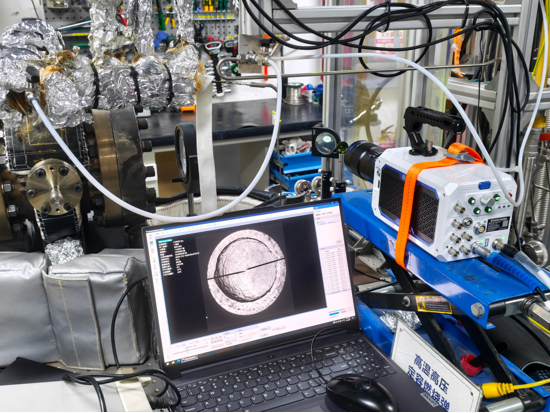
Image 1: Research setup for high-speed flaming research
The core of their imaging apparatus was the SinceVision SH8-125 camera. Deployed to image the high-pressure constant-volume combustion, the SH8 captured the exact moment of flame crack propagation at a staggering 129,000 frames per second (fps) at a spatial resolution of 384 × 384 pixels. This provided a flawless, uninterrupted record of the flame's structural evolution.
Spatiotemporal Mapping: The 4-Stage Evolution Breakdown
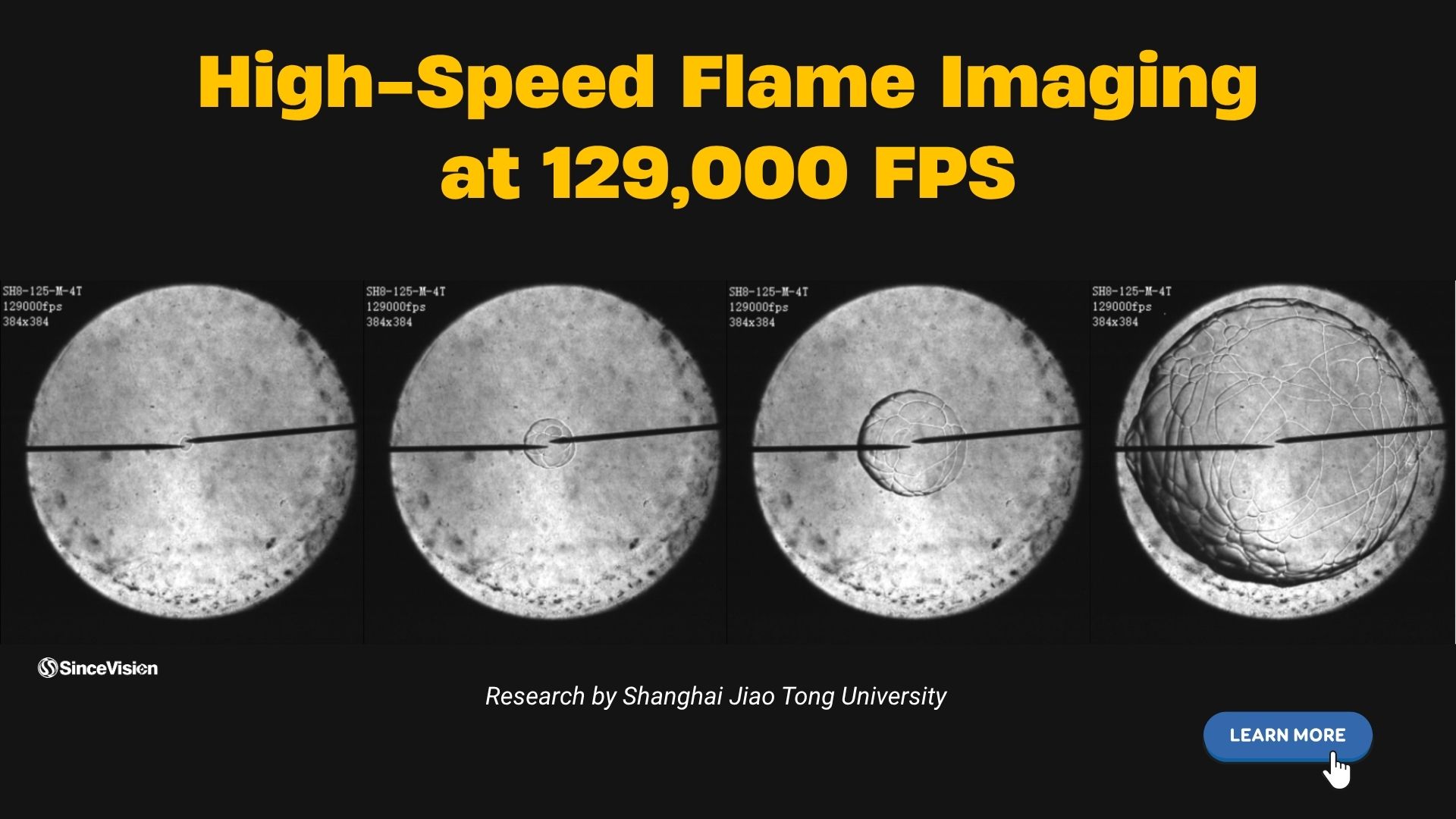
By utilizing back-illuminated sensor high-speed imaging, the SJTU research team successfully isolated the flame cellularization process into four distinct morphological stages. Crucially, the SinceVision SH8 provided over 100 valid frames across this ultra-short millisecond window, allowing for robust quantitative extraction of the flame radius, cellular wavelength, and curvature distribution.
Stage 1: Spherical Laminar Propagation Stage
In the initial milliseconds following ignition, the flame expands symmetrically. The camera captures a perfectly smooth spherical flame front characterized by an exceedingly thin, stable reaction layer. No macroscopic deformations are present at this phase.
Stage 2: Initial Perturbation & Crack Initiation
As expansion continues, hydrodynamic and thermo-diffusive instabilities overcome the flame's restorative forces. The high-speed imaging reveals the onset of tangential perturbations along the flame surface. Driven heavily by the mixture's effective Lewis number (Leeff), microscopic cracks initiate and begin to distort the previously smooth boundary.
Stage 3: Crack Intersection & Secondary Branching
The flame enters a highly chaotic transitional phase, crossing the critical Peclet number (Pec). The SH8 captures rapid, cascading structural failures across the flame surface, characterized by distinct T-shaped and Y-shaped bifurcations. Cracks intersect, and secondary branching propagates rapidly, tearing the primary cellular structures into smaller sub-cells.
Stage 4: Fully Cellularized State
The flame front completely loses its spherical integrity, transitioning into a fully cellularized state. The surface is dominated by irregular, densely packed chaotic cells. This topological shift causes a dramatic increase in the flame surface area, triggering localized self-acceleration and driving the transition toward full turbulence.
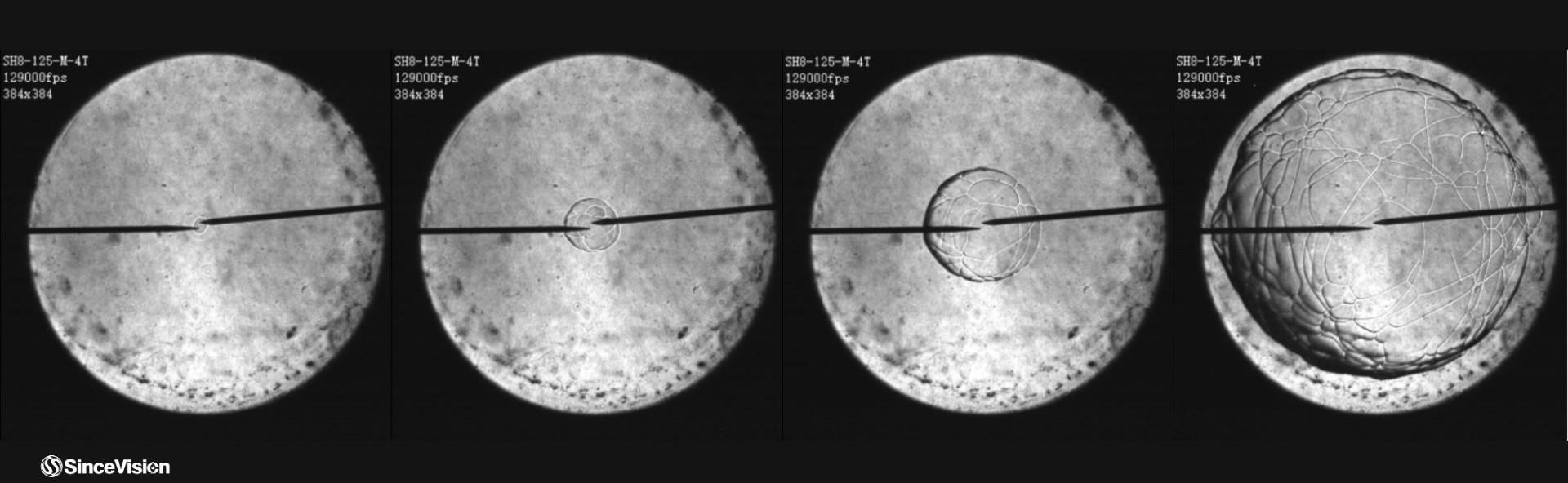
Image 2: Schlieren flame imagery from the SJTU experiment
Hardware Performance Breakdown: Why the SH8 Series Succeeded
The success of the SJTU constant-volume combustion chamber visualization relied on three specific architectural advantages of the SinceVision SH8 series:
Extreme Temporal Resolution: Operating at 129,000 fps yields a frame interval of exactly 7.8 µs. This microsecond-level temporal density is mandatory to prevent data loss during the sub-millisecond crack branching phase, ensuring no bifurcations occur "between frames."
High Sensitivity (BSI Sensor): The camera utilizes a highly advanced Back-Illuminated Sensor (BSI) architecture boasting a peak quantum efficiency (QE) of ≥85%. Combined with its specialized hardware binning mode, the sensor maximizes photon capture, producing crisp, high-contrast flame shadow edges even under the low-light, high-gradient conditions inherent to Schlieren or shadowgraph setups at 7.8 µs exposures.
Perfect Spatial Balance: By maintaining a 384 × 384 pixel resolution at maximum frame rates, the SH8 achieves the optimal balance. It provides a wide enough macro field-of-view to track overall flame expansion, while retaining sufficient pixel density to resolve micrometric micro-curvature changes along the cellular boundary.
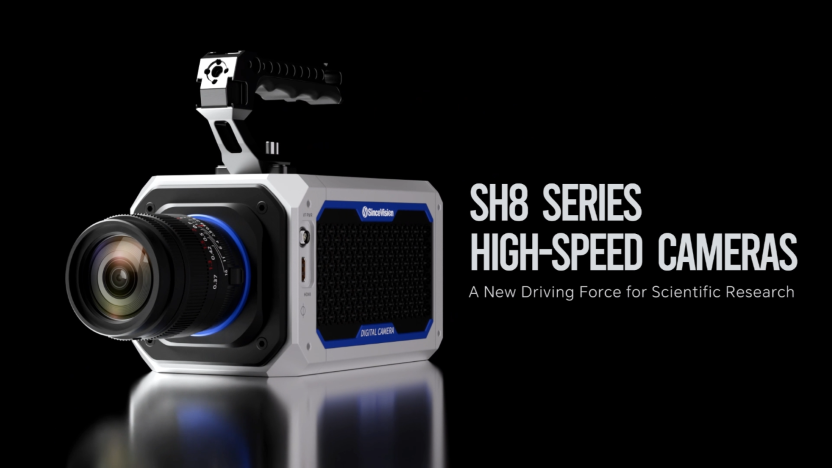
Image 3: SinceVision's new SH8 Series high-speed camera
High-Speed Camera Flame Imaging: Hardware Comparison
| Performance Metric | Traditional High-Speed Cameras | SinceVision SH8 Series |
| Sensor Architecture | Front-Illuminated (FSI) | Back-Illuminated (BSI) with ≥85% QE |
| Max fps at 384 × 384 | ~20,000 - 50,000 fps | 1.1 million fps |
| Exposure Capability | Motion blur in sub-millisecond events | 7.8 µs intervals (freezes micro-cracks) |
| Low-Light / Shadowgraph | High noise, degraded edge detection | High contrast, hardware binning supported |
| Usable Frames per Event | < 20 frames per millisecond | > 100 frames per millisecond |
Frequently Asked Questions (FAQs)
How does the SinceVision SH8 handle extreme low-light conditions at 129,000 fps?
At 129,000 fps, exposure times are severely limited. The SH8 mitigates this through a combination of a back-illuminated (BSI) sensor with ≥85% peak QE, large pixel pitch, and hardware binning modes that exponentially increase light sensitivity without introducing artificial software noise.
Can the SH8 synchronize seamlessly with laser diagnostic systems (e.g., PLIF or PIV)?
Yes. The SH8 series features ultra-low latency programmable TTL triggering and external synchronization hardware, allowing it to lock in perfectly with pulsed nanosecond lasers and synchronized timing units used in advanced combustion diagnostics.
Why is a 384 × 384 resolution considered optimal for this specific experiment?
In high-speed imaging, bandwidth is finite; increasing resolution lowers the maximum frame rate. 384 × 384 represents the mathematical "sweet spot" for cellular instability studies. It provides just enough spatial pixel density to resolve 10-50 µm flame thickness while unlocking the crucial >100,000 fps threshold required to map sub-millisecond temporal kinetics.
Advance Your Combustion Diagnostics Today: Achieving accurate data extraction in highly transient reacting flows requires zero compromises in imaging hardware. To see how the SinceVision SH8 series can elevate your high-speed camera flame imaging, request the full technical datasheet or schedule a virtual demonstration with one of our imaging application specialists today.

Featured Camera
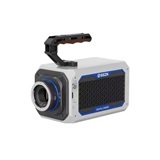
SH8-125
You can also read
Unlocking Flame Cellular Instability: Advanced High-Speed Camera Flame Imaging with the SinceVision SH8 Series
Oct 09, 2026
Analyzing Brittle Fracture in Tomato Roots: A SinceVision High-Speed Camera & DIC Experiment for Agricultural Robotics
Sep 01, 2026
3D Laser Profiler for Lithium-Ion Battery Top Cover Bonding Height Measurement
Aug 14, 2026
Observation of Embryonic Fibroblasts with sCMOS Camera for Multichannel Imaging
Jun 23, 2026
Automating Automotive Body Gap Detection with the SinceVision SR8060H 3D Laser Profiler
Jun 05, 2026



 Compare
 Clear the comparison bar
