










Upcoming SRI6000 Series 3D Laser Profiler: How Embedded Vision is Transforming 3D Inspection
SinceVision SRI6000 Series, specifically the SRI6480 model, is a true embedded vision 3D laser profiler that eliminates the requirement for external controllers in industrial automation. The hardware integrates an internal FPGA, an 8 core CPU, and a dedicated NPU to perform raw data extraction, 3D coordinate calculation, and adaptive contour extraction algorithms natively.
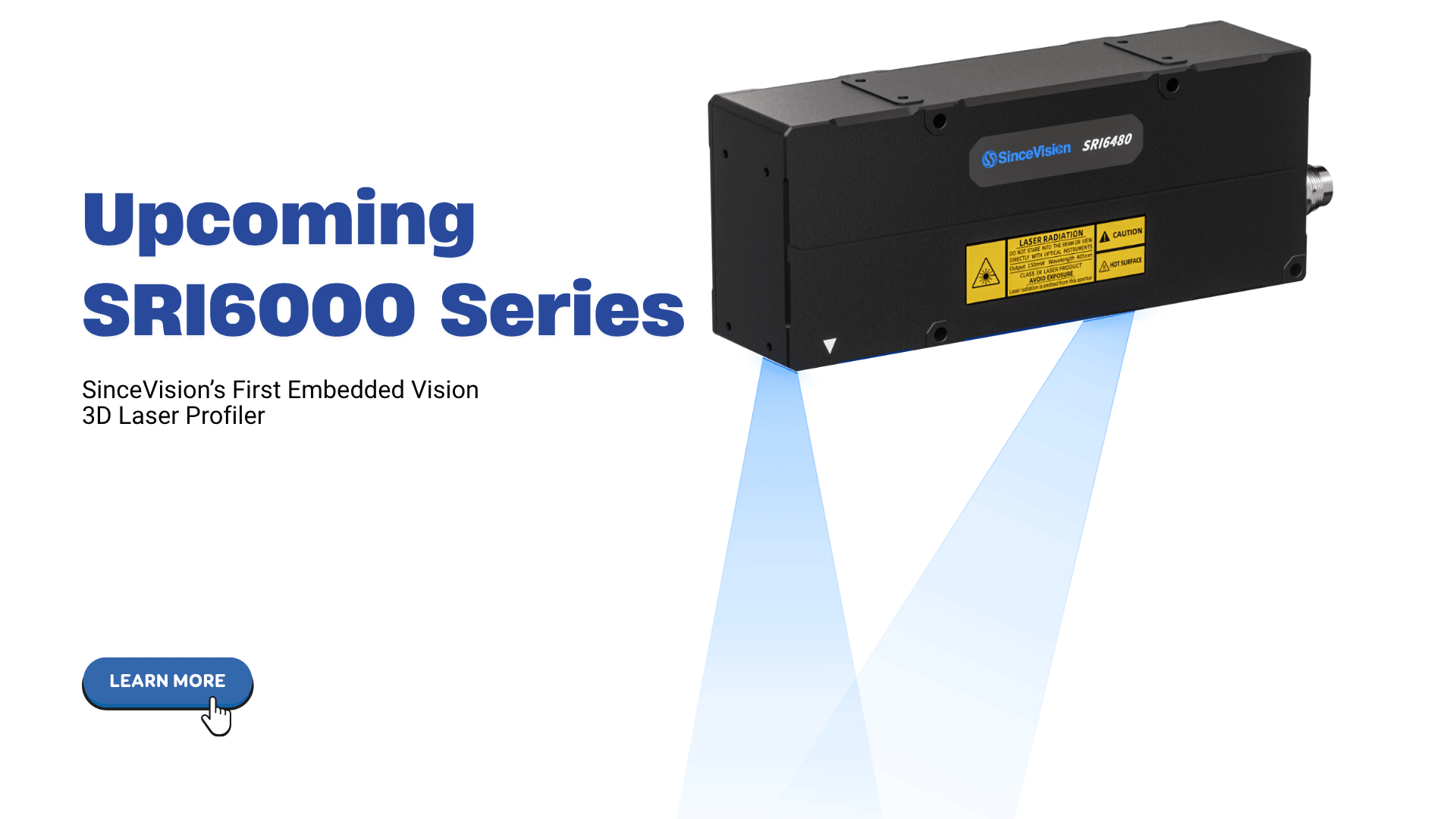


For years, achieving high-speed 3D laser profiling required a significant compromise: managing bulky external hardware. Traditional inline 3D inspection architectures rely on sensor heads that capture raw data, which is then transmitted via heavy cabling to an external controller or industrial PC for processing.
As production lines in the automotive, tire, and electronics industries accelerate, this legacy architecture introduces a critical bottleneck: data transmission latency. The solution is edge computing.
By integrating the processing power directly into the sensor head, the machine vision industry is undergoing a massive shift toward embedded vision. Here is why moving 3D profiling to the edge is fundamentally changing how integrators approach automated quality control.
The True Definition of Embedded Vision in 3D Profiling
There is a distinct difference between an integrated device and a true embedded vision system. While an integrated 3D laser profiler simply houses optical components and standard computational hardware within the same unit, an embedded vision system is purpose-built for edge processing from the ground up.
An embedded vision 3D laser profiler combines a laser line projector and an intelligent smart camera system into a single housing to calculate 3D coordinates on-board .
Instead of exporting raw images to a central PC, the internal image processing module handles the heavy lifting of raw data extraction and coordinate calculation instantaneously. Only the final, actionable measurement data such as step height, flatness, or defect coordinates—is output directly to the factory network via TCP/IP or Modbus RTU.
A First Look at the SinceVision SRI6000 Series
Recognizing the need for zero-latency inspection and simplified integration, SinceVision is introducing the SRI6000 Series—our first-ever 3D laser profiler portfolio built on a true embedded vision architecture.
The upcoming SRI6480 model takes this architecture a step further. By combining the internal FPGA's real-time coordinate calculation with a powerful on-board 8-core CPU and dedicated NPU, the device executes advanced adaptive with Contour Extraction Algorithm natively. This provides integrators with a one-stop solution without the footprint of an external controller.
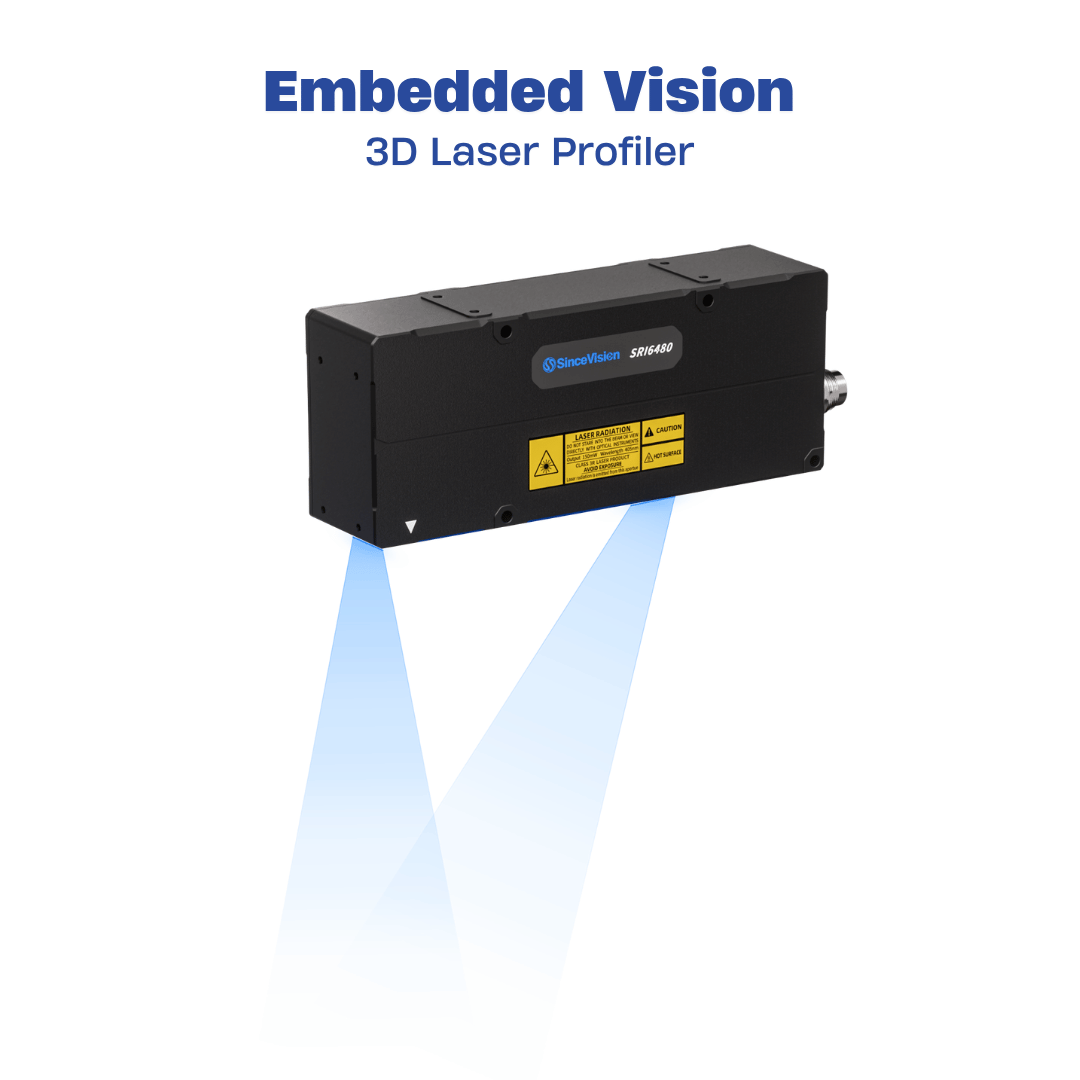
The Power of the Dedicated Neural Processing Unit (NPU)
For 3D laser profilers, an NPU shifts the paradigm from simple geometric calculations to intelligent scene comprehension. By understanding the context before it measures and judges, this new generation of profilers achieves the perfect balance of precision and smart automation.
A Neural Processing Unit (NPU) is a computing unit specifically designed for neural network inference. While a CPU relies on a small number of cores to execute complex instructions sequentially, an NPU integrates a large-scale parallel multiply-accumulate (MAC) array. It can perform a large number of operations in network layers—such as convolutions and fully connected layers—in real time with extremely low power consumption and very high throughput. As a result, it is ideally suited for deployment on edge devices like sensors, where computing power, power consumption, and size are all limited.
Uncompromising Speed and Precision
Even with all image processing occurring at the edge, the SRI6480 achieves scanning speeds ranging from 750 Hz to 10,000 Hz. The sensor captures 3,200 X-axis contour points with a 65 μm data interval, easily detecting surface defects as small as 0.6 × 0.6 × 0.4 mm in depth.
Wavelength Adaptability
One of the most persistent challenges in inline 3D profiling is material reflectivity. To solve this, the SRI6480 offers optional 405 nm (blue light) and 650 nm (red light) laser options, ensuring reliable contour extraction across a wide variety of industrial materials.
The Impact on Industrial Automation
Moving processing to the edge allows for tighter tolerances at higher line speeds. For example, in automotive precision manufacturing, the SRI6480 can detect step heights with an accuracy of 0.03 mm and a flatness of 0.04 mm, while the target is moving at speeds exceeding 200 mm/s.
"By running adaptive Contour Extraction Algorithm natively on the device, we are providing integrators with a true one-stop solution. The SRI6480 delivers exceptional imaging quality and immediate depth data without the friction of external hardware."
— Kevin Cheng, Europe Sales Director, SinceVision
See the Future of Edge Inspection at VISION 2026
The transition to embedded 3D profiling reduces cabinet space, simplifies cabling, and maximizes throughput. SinceVision will offer an exclusive first look at the SRI6000 Series before its official international market launch.
Join us at VISION 2026:
● Dates: October 6–8, 2026
● Location: Messe Stuttgart, Germany
● Booth: Hall 8, Booth 8A30

SRI Series Sensor
SRI8020
SRI8060K
SRI7300
SRI71600
You can also read
Upcoming SRI6000 Series 3D Laser Profiler: How Embedded Vision is Transforming 3D Inspection
Sep 15, 2026
Analyzing Brittle Fracture in Tomato Roots: A SinceVision High-Speed Camera & DIC Experiment for Agricultural Robotics
Sep 01, 2026
3D Laser Profiler for Lithium-Ion Battery Top Cover Bonding Height Measurement
Aug 14, 2026
Observation of Embryonic Fibroblasts with sCMOS Camera for Multichannel Imaging
Jun 23, 2026
Automating Automotive Body Gap Detection with the SinceVision SR8060H 3D Laser Profiler
Jun 05, 2026



 Compare
 Clear the comparison bar
