










Inline Tablet Thickness Measurement in Pharmaceutical Manufacturing Using Laser Displacement Sensors
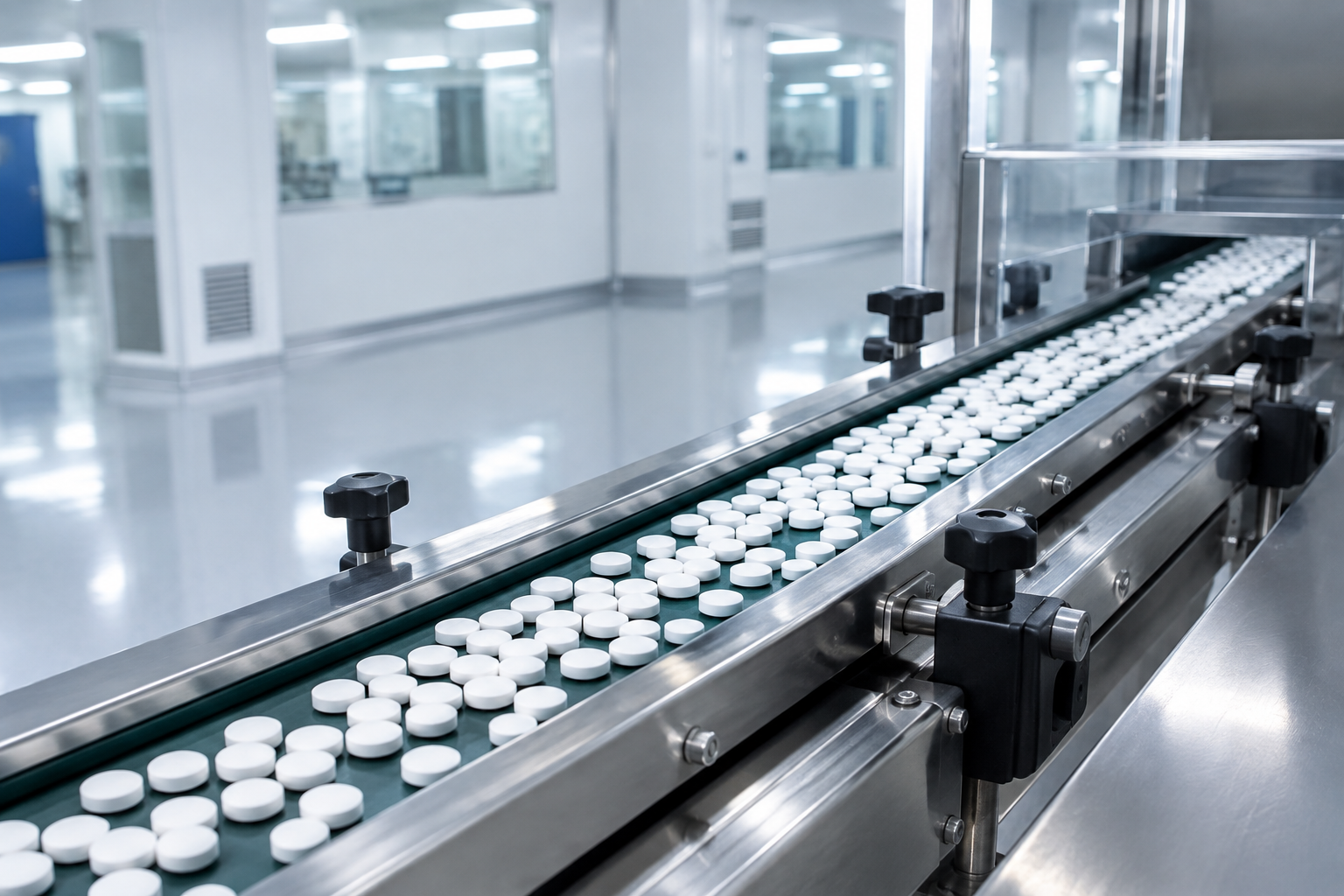
In pharmaceutical manufacturing, tablet thickness variation indicates compression force instability and directly impacts USP <905> content uniformity. The SinceVision SD33-30 point laser displacement sensor provides non contact inline thickness measurement to replace offline manual micrometers and mechanical contact probes.


Executive Summary
The Challenge: Tablet thickness variation is a primary indicator of compression force instability and weight variation, directly impacting content uniformity standards such as USP <905>.
The Solution: Integrating the SinceVision SD33-30 point laser displacement sensor provides continuous, non contact inline thickness measurement on high speed rotary tablet presses.
Key Specifications: The sensor delivers 2 μm repeatability, a 30 mm reference distance, and an adjustable sampling frequency of up to 3 kHz (3,000 measurements per second).
Engineering Impact: Transitioning to optical triangulation eliminates the sampling latency of manual micrometers and the physical tablet damage caused by mechanical contact probes, enabling 100 percent inline quality control.
The Engineering Challenge: Tablet Thickness and Content Uniformity
In solid dosage pharmaceutical manufacturing, tablet thickness is a critical In Process Quality Control (IPQC) metric. Variations in thickness directly indicate underlying problems in the rotary tablet press, including compression force fluctuations, powder flow inconsistencies, or punch wear.
When tablet thickness deviates from the standard tolerance (typically ±5 percent), it triggers a cascade of downstream failures. Overly thick tablets suffer from low hardness and high friability, causing them to chip or break during coating. Overly thin tablets indicate excessive compression force, which delays dissolution rates and alters drug bioavailability. Furthermore, inconsistent tablet geometry causes severe jamming in secondary blister packaging machines. To comply with pharmacopeial standards for weight variation and content uniformity, manufacturers must detect these mechanical anomalies instantly.
Relying on traditional manual sampling using digital vernier calipers presents a severe latency risk. An operator measuring 10 tablets every 15 to 30 minutes leaves massive blind spots. During a 15 minute gap, a high speed rotary press can produce tens of thousands of out of spec tablets, resulting in mandatory batch quarantines, expensive rework, or complete batch rejection.
Non-Contact Optical Triangulation for High Speed Lines
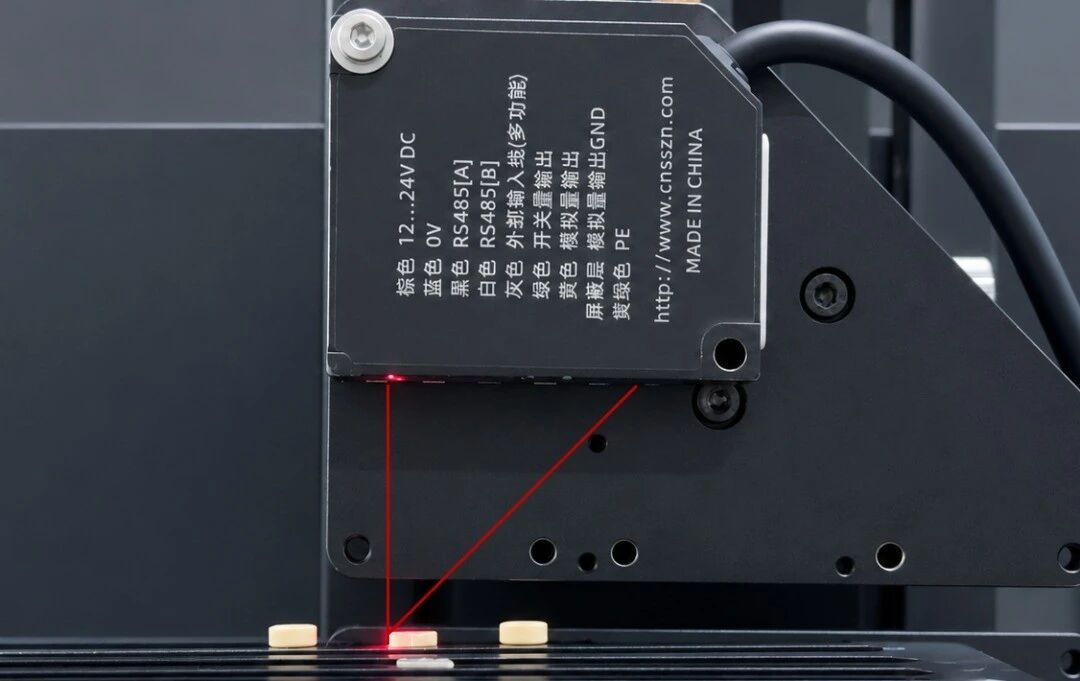
To achieve 100 percent inline inspection without slowing down production, pharmaceutical engineers deploy the SinceVision SD33-30 laser displacement sensor directly above the discharge chute or conveyor track of the rotary press.
Unlike mechanical contact probes (LVDTs) that rely on physical touch, the SD33-30 utilizes non contact optical triangulation. A focused laser beam projects onto the passing tablet surface. The diffuse reflection is captured by an internal CMOS receiving array. As the tablet height changes, the reflection angle shifts. The sensor calculates this angular displacement to determine the absolute vertical height of the tablet with micrometer precision.
The SD33-30 is specifically engineered for strict industrial environments. It features a 30 mm reference distance and a ±4 mm measurement range. This large standoff distance keeps the sensor safely away from the tablet flow, preventing dust accumulation on the optics and eliminating the risk of physical jamming on the production line.
Technology Comparison: Tablet Thickness Inspection Methods
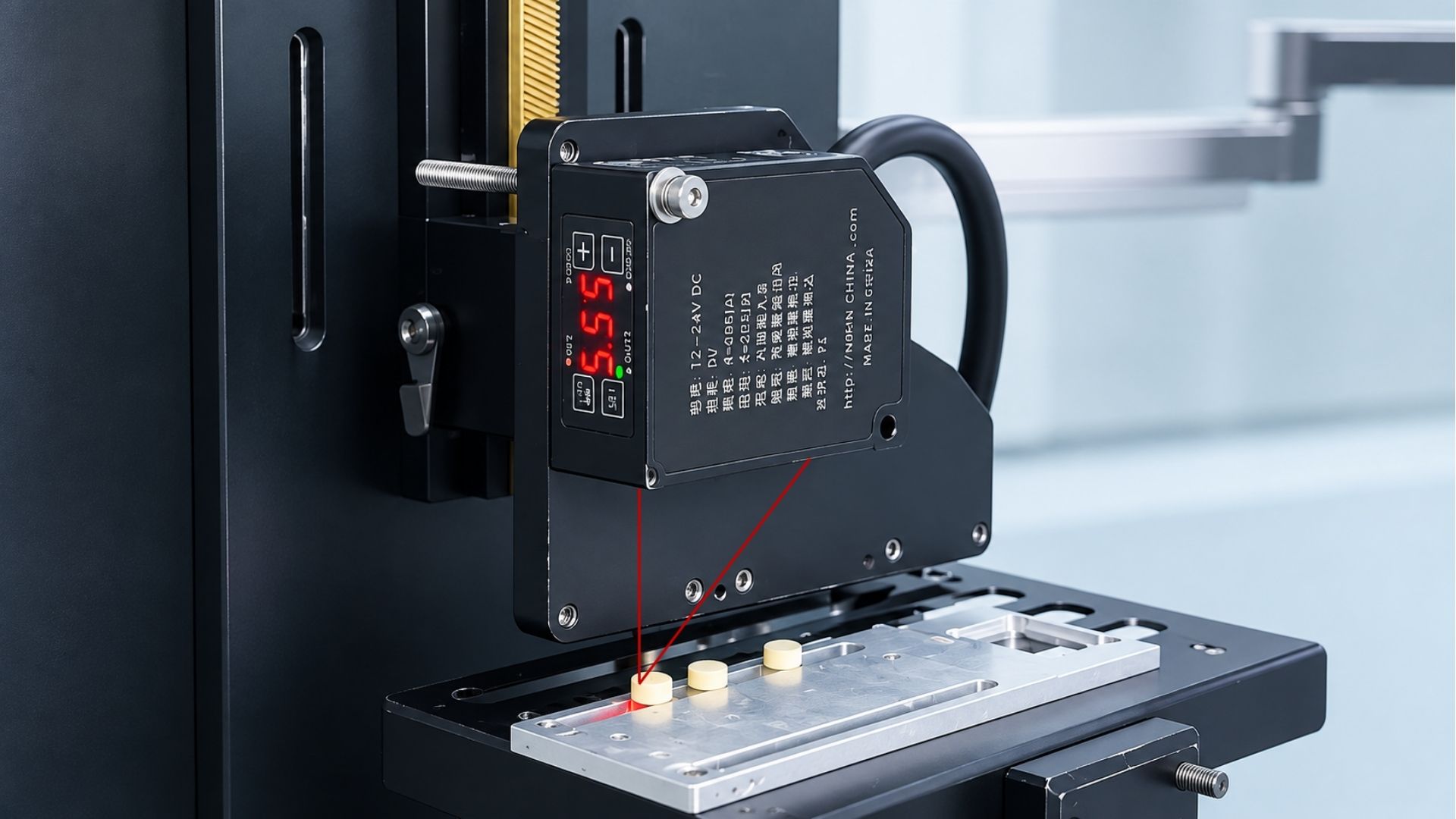
| Inspection Method | Measurement Principle | Inspection Rate and Coverage | Contact Risk | Suitability for High Speed Lines |
| Manual Micrometer | Physical offline caliper | Extremely low (Batch sampling only) | High (Operator handling) | Poor (Creates quality control latency) |
| Inline Contact Probe (LVDT) | Mechanical spring loaded tip | Moderate (Prone to bouncing at high speeds) | High (Scratches friable tablets, gathers dust) | Moderate (Mechanical inertia limits throughput) |
| SinceVision SD33-30 Laser | Optical point triangulation | Very High (3 kHz sampling; 100 percent inline coverage) | None (Purely optical measurement) | Excellent (Direct digital output to PLC) |
Hardware Specifications and Production Impact
High speed rotary tablet presses operate at extreme velocities. To match these production cycles, the inspection hardware must capture data instantaneously.
The SinceVision SD33-30 provides the following critical specifications:
3 kHz Sampling Frequency: Capturing 3,000 height measurements per second allows the sensor to record multiple data points across a single tablet, even at line speeds exceeding 500,000 tablets per hour.
2 μm Repeatability: This ultra high precision captures the most subtle tooling deviations, identifying punch wear before it causes major batch failures.
±0.1% F.S. Linearity: Ensures the measurement remains perfectly accurate across the entire ±4 mm range, accommodating seamless changeovers between different dosage forms and tablet specifications.
By eliminating mechanical contact, the SD33-30 prevents tablet abrasion and minimizes cleaning validations. The high speed continuous sampling transforms tablet thickness from a lagging offline metric into a real time, deterministic process control parameter.
Frequently Asked Questions (FAQs)
Why is non contact laser measurement superior to inline contact probes for tablets?
Mechanical contact probes (like LVDTs) require a physical tip to ride over the tablet. At high speeds, the physical tip bounces, creating false readings. Furthermore, the friction wears down friable tablets, causing cross contamination and generating excess powder dust that jams the sensor mechanism. Non-contact lasers eliminate friction, bouncing, and contamination entirely.
How does tablet thickness correlate to tablet hardness?
Thickness and hardness have an inverse relationship under constant die fill conditions. If the compression force drops, the resulting tablet will be thicker and softer (lower hardness). If the compression force spikes, the tablet will be thinner and harder. Monitoring thickness inline provides a real time proxy for compression stability.
Can the SD33-30 measure different tablet shapes and coatings?
Yes. The SD33-30 laser displacement sensor is equipped with advanced exposure control algorithms. It automatically adjusts to different surface reflectivities, providing stable height data for uncoated raw tablets, glossy film coated tablets, and enteric coated dosage forms without requiring manual recalibration.

Featured Sensor
SD33-30
You can also read
Unlocking Flame Cellular Instability: Advanced High-Speed Camera Flame Imaging with the SinceVision SH8 Series
Oct 09, 2026
Analyzing Brittle Fracture in Tomato Roots: A SinceVision High-Speed Camera & DIC Experiment for Agricultural Robotics
Sep 01, 2026
3D Laser Profiler for Lithium-Ion Battery Top Cover Bonding Height Measurement
Aug 14, 2026
Observation of Embryonic Fibroblasts with sCMOS Camera for Multichannel Imaging
Jun 23, 2026
Automating Automotive Body Gap Detection with the SinceVision SR8060H 3D Laser Profiler
Jun 05, 2026



 Compare
 Clear the comparison bar

