










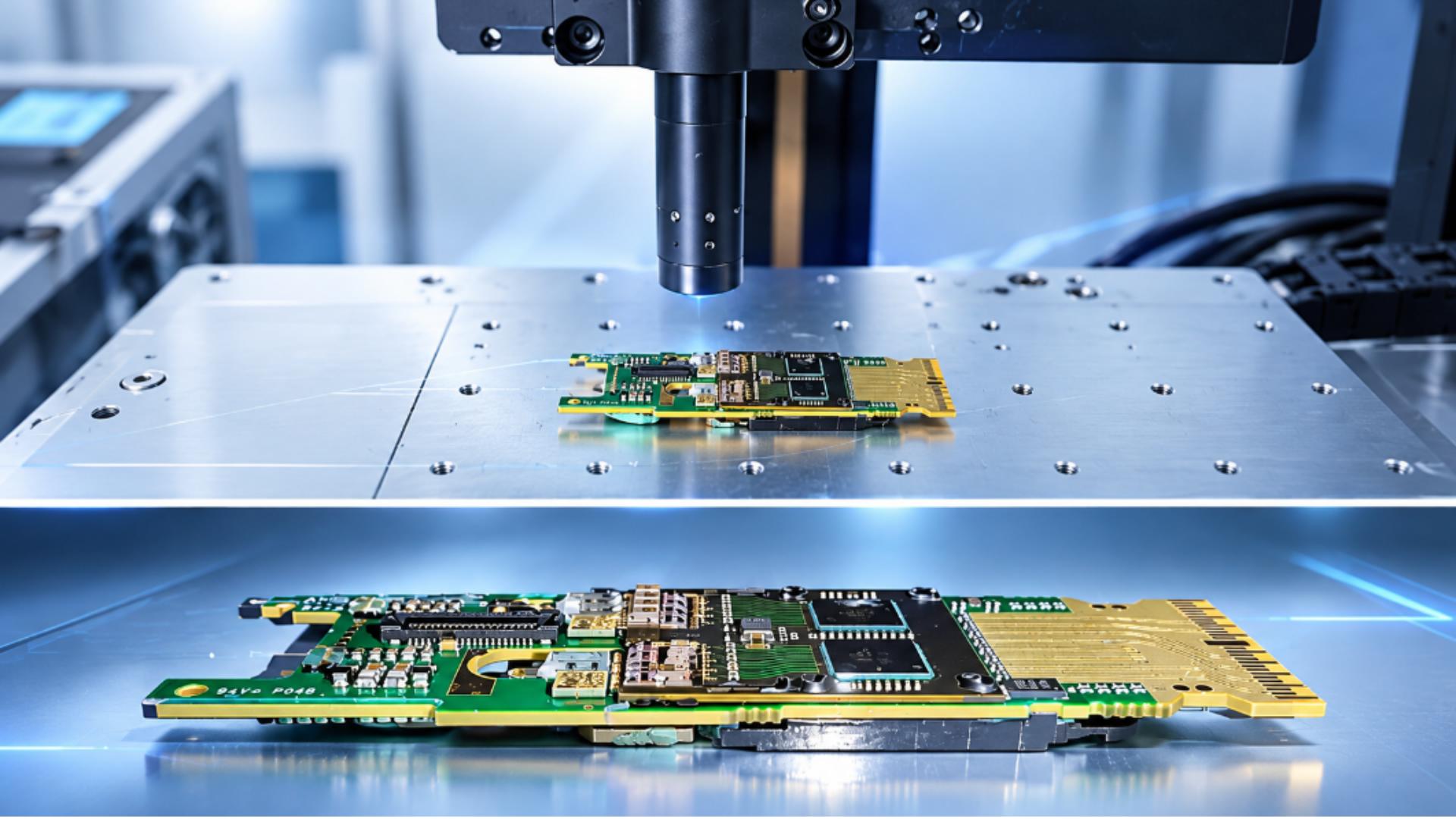
Precise FA Coupling for 1.6T Optical Modules Using Spectral Confocal Metrology
To achieve precise fiber array (FA) to photonic integrated circuit (PIC) coupling in 1.6T optical modules, manufacturers utilize the SinceVision spectral confocal displacement sensor. Operating at 33 kHz with 0.006 μm resolution, this non-contact metrology solution accurately measures relative tilt angles and distinguishes the upper and lower surfaces of transparent materials to prevent mechanical scratching during automated alignment.
 Product Inquiry
As high-speed optical modules evolve toward 1.6T data rates, the coupling precision between the internal fiber array (FA) and the photonic integrated circuit (PIC) becomes highly critical. Even minute deviations in planar tilt can cause end face contact or mechanical scratches during the automated coupling process. This degrades optical performance and causes severe device damage. Accurately identifying the relative tilt angle between these two components prior to physical alignment is a mandatory step in modern precision manufacturing.
The Metrology Challenges of Fiber Array Alignment
Achieving optimal yield during the FA coupling process presents three distinct inspection challenges:
Micro-Positioning Vulnerability: FAs feature microscopic structures. The exact planar orientation between the FA and the PIC must be calculated prior to physical movement to avoid contact damage resulting from tilt deviations.
Transparent Material Interference: The transparent substrates used in fiber arrays contain multiple optical interfaces. Standard inspection lasers suffer from severe reflection interference, failing to distinguish between upper and lower surfaces when attempting to measure height.
Automated Throughput Demands: Scaling optical module production requires inspection systems that deliver absolute sub-micron accuracy alongside the rapid response times necessary for automated alignment robotics.
Spectral Confocal Sensor Integration
To solve these positioning constraints, SinceVision deploys the spectral confocal displacement sensor.
By utilizing spectral confocal principles, this sensor isolates specific wavelengths to identify the top and bottom surfaces of transparent substrates. This optical method eliminates reflection interference from multi-layer interfaces, yielding absolute height data for precise planar attitude analysis.
Core Advantages for Optical Manufacturing
The confocal sensor optimizes automated 1.6T optical module FA coupling by balancing high-speed inspection with extreme metrology accuracy.
High-Precision Resolution: Operating with a resolution of 0.006 μm and a linearity of ±0.8 μm, the sensor guarantees exact planar alignment and prevents PIC damage.
High-Speed Sampling: A maximum sampling frequency of 33 kHz supports the rapid cycle times required in high-volume photonic integrated circuit manufacturing.
Transparent Material Compatibility: The spectral confocal architecture specifically targets optical materials, providing stable transparent material thickness measurement without signal loss or multi-surface confusion.
Non-Contact Inspection: The system completely eliminates physical force on fragile optical components, preserving surface integrity while calculating the critical relative tilt angle.








 Compare
 Clear the comparison bar

