










How Automotive Manufacturers Can Accurately Measure Conformal Coating Thickness on PCBA
Automotive electronics require reliable conformal coating thickness to prevent corrosion and circuit failures. This article shows how spectral confocal displacement sensors solve the measurement challenges that traditional methods cannot handle—transparent coatings, reflective pins, tight spaces, and high line speeds.
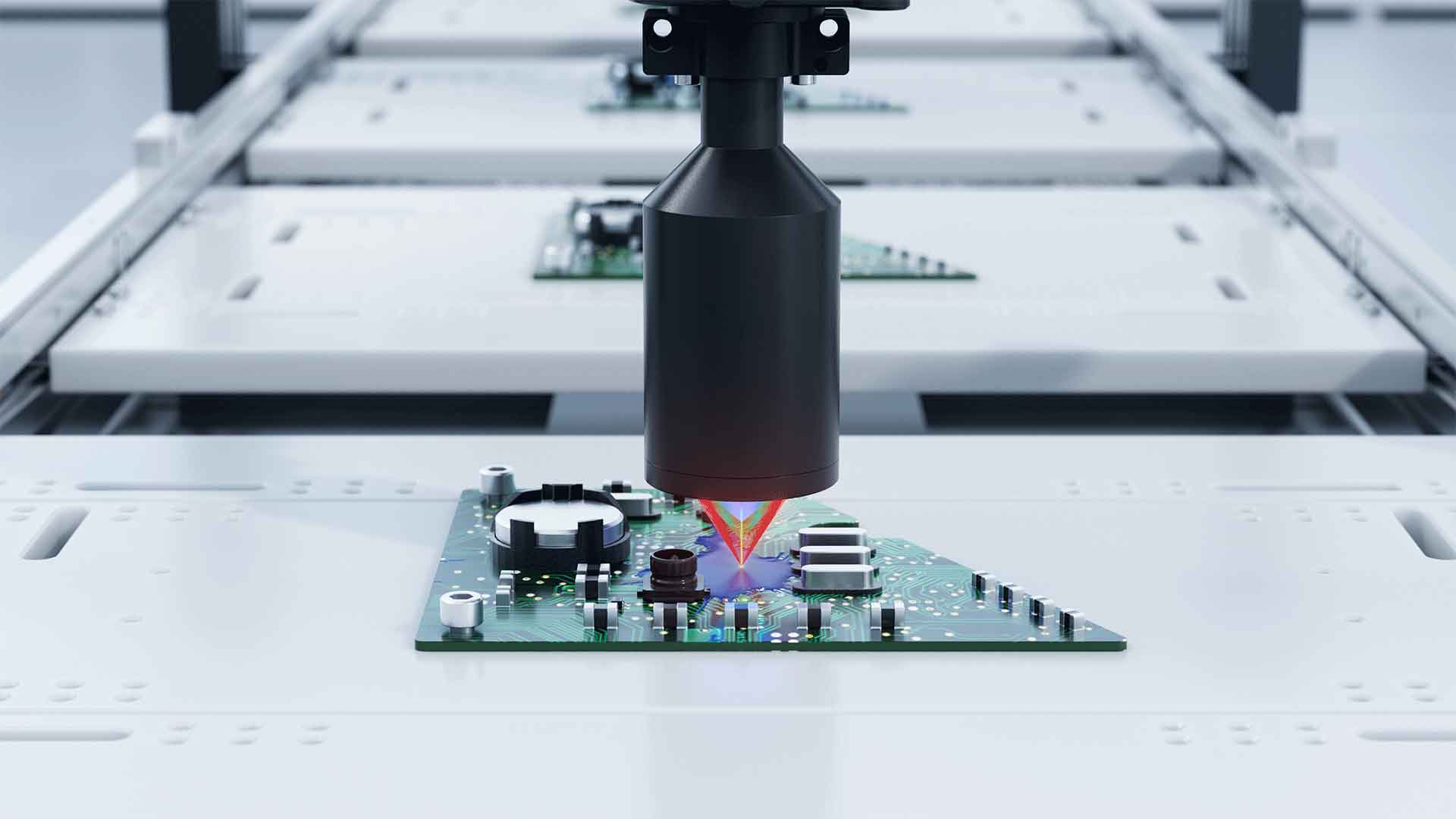


Getting conformal coating thickness right on automotive PCBA is not a nice-to-have. It's a safety and reliability requirement. Too thin and you risk corrosion and short circuits. Too thick and you can create stress on components or trap heat. The challenge has always been measuring it accurately, repeatably, and at production speed. This article explains how a spectral confocal displacement sensor solves that problem for high-density automotive boards.
Why traditional methods fall short
Most automotive electronics manufacturers have experienced these pain points:
Hard-to-reach areas go uninspected: Chip edges, connector pins, and tightly packed component zones rarely get proper coverage. Critical safety parts often carry the highest risk of a missed defect simply because they are difficult to access.
Precision drifts between batches: Standard inspection tools show too much variation. Without clear, stable data, quality teams struggle to define tight pass/fail limits that can hold up in an audit.
Transparent coatings confuse standard sensors: Laser triangulation, for example, has trouble with clear conformal coatings and highly reflective metal surfaces. Curved edges, pins, and rough textures make the measurement unreliable.
Inline inspection becomes a bottleneck: Many traditional non-destructive testers are too slow or too delicate to mount on a moving line. The result is either a slow manual sampling process or a production hold that reduces overall output.
How a spectral confocal displacement sensor works
A spectral confocal displacement sensor uses white light focused through a lens system that separates wavelengths along the measurement axis. When the light hits a transparent coating on a substrate, two distinct reflective peaks appear: one from the coating surface and one from the surface underneath. By factoring in the refractive index of the coating material, the system calculates the exact distance between those two peaks. That distance is the coating thickness.
The process is non-contact, so there is no risk of scratching or deforming the uncured or cured coating. The measurement spot is tiny, allowing access to cramped areas. The technology handles clear, semi-translucent, and even lightly pigmented coatings, and it is largely unaffected by the reflectivity of the underlying metal or board surface.
Applying the method inline on automotive PCBA
Automotive production lines require an inspection routine that matches the takt time. A practical setup works like this:
Vision-guided positioning: After coating and curing, a camera system locates the board and guides the sensor probe to 5 to 9 preset measurement points. These points are chosen based on previous failure analysis—typically chip edges, fine-pitch connector pins, and any high-risk high-density areas.
Fast single-point sampling: A capable spectral confocal sensor completes a single measurement in 0.5 seconds or less. That makes it realistic to inspect all selected points on one board within a 5 to 8 second window, keeping pace with high-speed conveyors.=
Real-time thickness evaluation: The system instantly compares each reading against predetermined limits, for instance 30 µm to 200 µm. The dual-peak calculation provides a thickness value derived from physical wavelength shift, not from an indirect estimation, so the data is traceable and auditable.
Safe working distance: A 25 mm standoff gap between the sensor probe and the tallest component prevents collisions, even when the board position is not absolutely rigid. This distance makes inline robotic integration straightforward.
The sensor that makes it practical: SinceVision SCI00532
The measurements described above are not theoretical. They are delivered by sensors like the SinceVision SCI00532, a point spectral confocal displacement sensor built specifically for thickness measurement tasks. In an automotive PCBA environment, the following specifications translate directly into production-grade confidence:
Micron-level resolution: A resolution of 0.006 µm and linear accuracy of ±0.2 µm mean you can reliably detect a thickness deviation of a few microns, even on thin 30 µm coatings. Batch-to-batch consistency becomes measurable and improvable.
Stable on challenging materials: Proprietary photosensitive algorithms allow the sensor to handle highly transparent coatings on bright metal pins, as well as rougher, low-reflectivity board surfaces. The measurement does not break down when the substrate changes from copper to solder mask to connector metal.
Speed that eliminates the inspection bottleneck: A 33 kHz sampling rate ensures that 0.5 second per-point measurement cycle is not limited by the sensor. The sensor head collects data far faster than the mechanical movement, so full-board inspection fits within the 5 to 8 second production window.
Robust inline fit: The 25 mm working distance gives the necessary clearance for dense automotive PCBA. The sensor can be mounted on a gantry, robot, or dedicated inspection station without special vibration isolation.
Moving from sample inspection to full-board traceability
When you combine a fast spectral confocal sensor with automated positioning, you shift from destructive or offline spot checking to inline, non-destructive measurement. Every board gets verified at the high-risk points. Data is stored per serial number, which supports continuous process control and failure analysis. Over time, the measurement dataset allows you to tighten coating process windows and reduce over-application of material.
Bringing the solution into your production
A spectral confocal displacement sensor eliminates the common pain points of conformal coating inspection. It reaches tight spaces, handles transparent materials, delivers repeatable micron-level data, and keeps up with the line speed. For automotive manufacturers who need to prove coating integrity without slowing down production, this is an engineering path worth evaluating.
Request a demo to see the SinceVision SCI00532 measuring coating thickness on your own boards at full production speed.

Featured Sensor
SCI00532
You can also read
Unlocking Flame Cellular Instability: Advanced High-Speed Camera Flame Imaging with the SinceVision SH8 Series
Oct 09, 2026
Analyzing Brittle Fracture in Tomato Roots: A SinceVision High-Speed Camera & DIC Experiment for Agricultural Robotics
Sep 01, 2026
3D Laser Profiler for Lithium-Ion Battery Top Cover Bonding Height Measurement
Aug 14, 2026
Observation of Embryonic Fibroblasts with sCMOS Camera for Multichannel Imaging
Jun 23, 2026
Automating Automotive Body Gap Detection with the SinceVision SR8060H 3D Laser Profiler
Jun 05, 2026



 Compare
 Clear the comparison bar
