











Application of DIC Technology and Motion Analysis in Golf Ball Stress Measurement
To accurately quantify the mechanical performance of sports equipment, researchers utilize the SinceVision SH6-116 high-speed camera operating at 20,000 frames per second to conduct simultaneous Digital Image Correlation (DIC) and motion analysis on golf ball impacts. This non-contact optical measurement system captures full-field strain data and kinematic parameters to analyze extreme compressive deformation, providing definitive experimental evidence for golf ball R&D and patent infringement validation.
 Product Inquiry
Golf is a sport highly sensitive to precise equipment performance. As the sole dynamic medium involved in the game, the aerodynamic efficiency, launch trajectory, and tactile feel of a golf ball directly dictate an athlete's competitive performance. These mechanical characteristics depend entirely on the microstructural design of the outer surface of the ball, specifically the precise geometric shape, depth, and spatial distribution of its dimples.
During actual gameplay, the load conditions experienced by a golf ball vary drastically depending on the type of club used and the individual swing speed of the golfer. Different clubs, such as drivers, irons, and putters, apply distinct load forms. They act on different localized surface areas and exert varying magnitudes of kinetic force at the exact moment of impact. Furthermore, swing speed directly alters the degree of structural deformation and the resulting strain rate of the ball. Therefore, the direct measurement of deformation during the impact phase is a critical engineering step in evaluating functional performance.
1. The Metrology Challenge of High-Speed Impact
The impact process of a golf ball is characterized by an extremely short duration, massive deformation amplitude, and highly localized contact areas. Conventional physical measurement methods, such as attached strain gauges, fundamentally fail in this environment because they disturb the physical motion and aerodynamics of the ball. Traditional methods struggle to obtain accurate full-field deformation data without altering the exact parameters they are attempting to measure.
To solve this metrology constraint, researchers combined Digital Image Correlation experimental mechanics with high-speed motion analysis to establish a non-contact measurement system tailored specifically to the golf ball impact process. This methodology simultaneously captures global structural deformation and extracts precise kinematic parameters. This dual-faceted data provides the definitive experimental evidence required for both elite sports equipment development and strict performance comparisons in patent infringement determinations.
2. Experimental System Configuration
The optical measurement system utilized in this study primarily consists of a high-speed camera, a specialized optical lens, and a high-intensity light source. The specific hardware configuration guarantees the temporal and spatial resolution necessary for dynamic sports analysis.
Camera Model: SinceVision SH6-116
Resolution: 1280 × 768
Frame Rate: 20,000 fps
Lens Focal Length: 100 mm
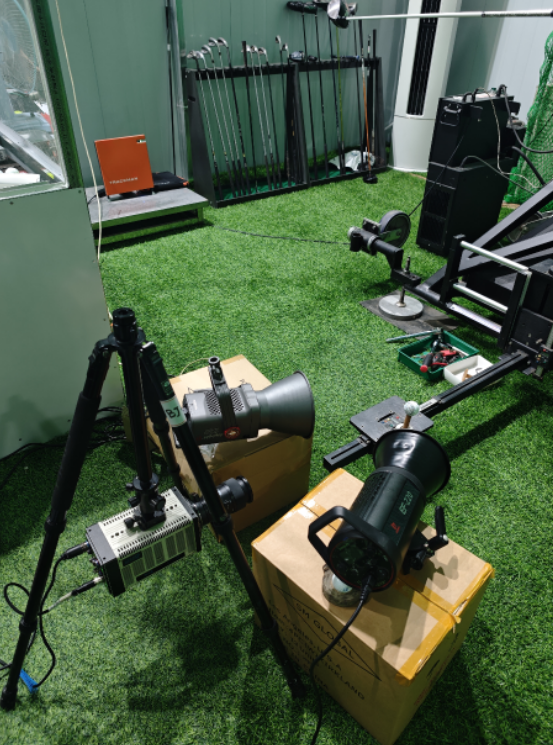
This hardware architecture is specifically engineered to capture high-frame-rate image sequences under extreme high-speed impact conditions. The 1280 × 768 resolution provides the exact spatial density required to analyze localized micro-deformations at the physical edges of individual dimples. Simultaneously, the 20,000 fps frame rate allows for the complete, uninterrupted recording of the transient deformation process exactly at the moment of impact.
The 100 mm lens, operating in conjunction with a 220W high-intensity light source, produces clear and exceptionally high-contrast speckle pattern images within an extremely short exposure window. This optical clarity provides the foundational raw data that meets the rigorous accuracy requirements for subsequent DIC strain measurement algorithms.
3. Dual-Analysis Methodology and Results
3.1 DIC Technology for Full-Field Strain
By applying a speckle pattern to the golf ball and performing algorithmic calculations on the acquired 20,000 fps image sequences, engineers successfully reconstructed the three-dimensional displacement and strain fields across the surface of the ball. This allowed the team to extract isolated deformation data under various club types and swing speed conditions.
The DIC analysis results definitively indicate that the golf ball undergoes significant and extensive compressive deformation at the exact instant of impact with the clubface. The generated DIC cloud map visually proves that the ball experiences pronounced localized compression in the primary contact area, with the deformation zone rapidly expanding outward as the millisecond impact process progresses.
The magnitude of this compressive strain is significantly greater than any physical stress experienced by the ball during its subsequent aerodynamic flight. This confirms that the moment of impact is the stage where the mechanical response of the material is most intense. The deformation data obtained from the DIC analysis and the calculated changes in the acceleration of the ball corroborate one another perfectly, collectively defining the mechanical response characteristics of the strike.
3.2 High-Speed Motion Analysis
Utilizing the exact same SinceVision SH6 Series high-speed camera image sequence, the subsequent trajectory of the golf ball was tracked and analyzed to extract core kinematic parameters.
The motion analysis results demonstrate a clear, quantifiable correlation between the physical deformation of the ball and its acceleration during contact. As acceleration increases upon initial club contact, the compressive deformation of the ball intensifies proportionally. As acceleration peaks and begins to decrease or change vector direction, the structural deformation adjusts accordingly.
Once the golf ball separates from the clubface and enters the free flight phase, it is no longer subjected to the continuous kinetic force of the club. During this aerodynamic phase, the velocity changes become relatively gradual over a short temporal period. The surface deformation rapidly tends to stabilize, and the significant compressive strain observed at the moment of impact does not recur.
4. Commercial and Legal Applications
Through the simultaneous application of advanced DIC technology and sports equipment motion analysis, this study successfully elucidated the complex mechanical behavior of a golf ball during a high-speed strike. The imaging proved that significant compressive deformation correlates directly with acceleration spikes and that the material stabilizes immediately upon entering the flight phase.
These quantitative results provide direct experimental evidence for evaluating the functional performance of golf balls engineered for different swing speeds and club faces. Furthermore, because this non-contact optical measurement yields objective, highly accurate strain and kinematic data, it serves as a critical scientific reference for conducting performance comparisons in complex golf ball patent infringement determinations, ensuring that intellectual property disputes are resolved using irrefutable physical data.







 Compare
 Clear the comparison bar

