










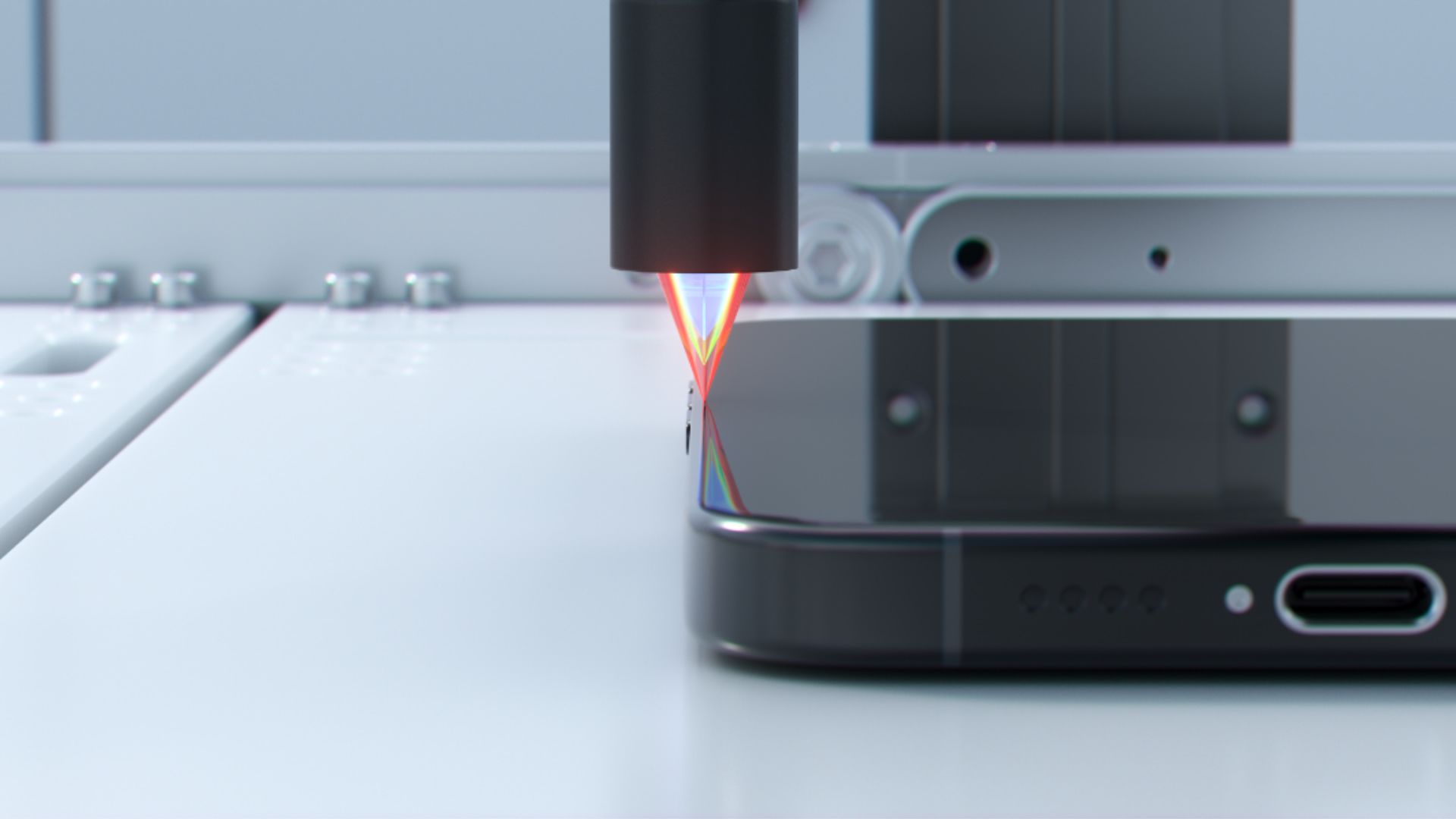
Detecting Microscopic Gaps Between Smartphone Screens and Mid-Frames with Spectral Confocal Sensors
To prevent water ingress, poor screen adhesion, and touchscreen malfunctions in mobile devices, manufacturers use the SinceVision SCI Series spectral confocal displacement sensor for smartphone screen gap inspection.
 Product Inquiry
The reliability of a smartphone depends not only on display resolution and internal hardware, but also on the mechanical precision of the assembly between the screen and the mid-frame.
If the gap between the display panel and the mid-frame is excessive or unevenly distributed, the structural seal degrades. This increases the risk of water ingress, weakens screen adhesion, and leads to touchscreen malfunctions. Performing rapid, accurate microscopic gap detection on the production line prevents assembly deviations from progressing into downstream manufacturing stages.
Metrology Challenges in Smartphone Display Assembly
Joining a smartphone display to a mid-frame combines dissimilar materials within a tight mechanical tolerance and a minimal inspection footprint. Conventional inspection methods encounter three persistent obstacles in mid-frame assembly metrology:
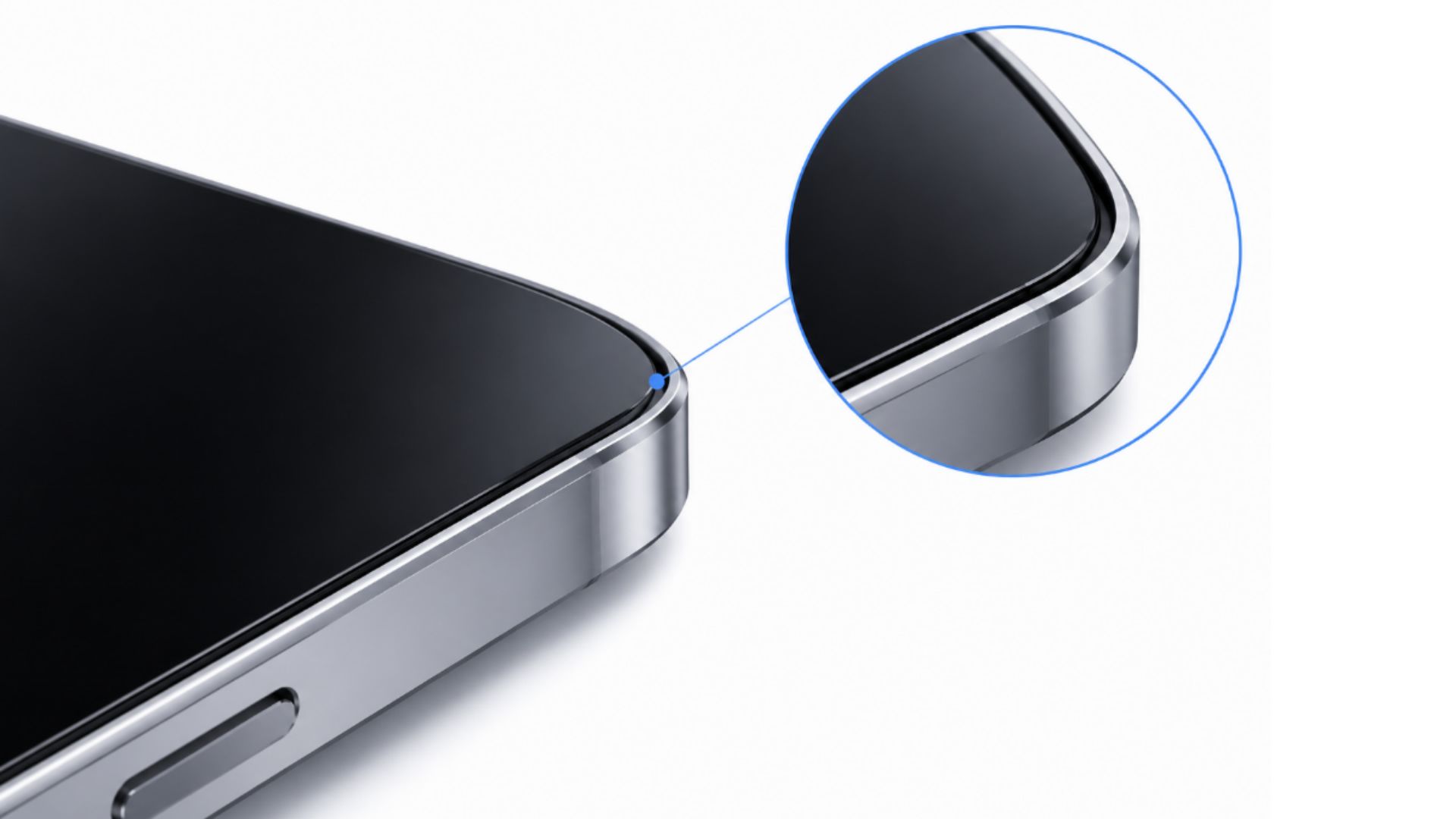
Sub-Micron Gaps and Edge Interference: Target gaps typically span from the sub-micrometer range to tens of micrometers. Because display edges incorporate chamfers, adhesive layers, and specular reflections, conventional optical sensors frequently confuse physical gaps with adjacent edge contours, causing severe measurement drift.
Multi-Material Optical Variance: Smartphone assemblies pair transparent cover glass directly against anodized or polished metal frames. The sharp contrast in optical reflectivity across these boundaries disrupts standard triangulation sensors.
High-Speed Production Cycle Times: Manual verification and slow offline sampling cannot keep pace with continuous, high-volume automated assembly lines, creating inspection bottlenecks and inconsistent defect screening.
Non-Contact Measurement Using the SinceVision SCI Series
To resolve these optical constraints, automated lines deploy the SCI Series spectral confocal displacement sensor.
During inline inspection, the sensor collects vertical displacement profiles around critical assembly points along the perimeter of the screen and the mid-frame. Each measurement is calibrated directly against the mid-frame reference plane or a predefined structural design reference. By computing the exact displacement differential between the display glass surface and the reference plane, the system quantifies both absolute gap size and distribution uniformity across the entire housing.
Key Capabilities and Engineering Impact
| Capability | SCI Series Performance | Production Line Advantage |
| Linearity | ±0.2 μm | Captures minute displacement shifts to flag early assembly deviations. |
| Material Compatibility | Glass, metal, ceramic, plastic, reflective surfaces | Handles mixed display and housing materials without recalibration. |
| Measurement Method | 100% non-contact optical | Eliminates physical contact scratches on cover glass and coated frames. |
| Line Integration | High-speed automated response | Eliminates manual re-inspection and secondary offline verification. |
Core Advantages for Automated Display Assembly
±0.2 μm Linearity for Micron-Level Deviations: High measurement linearity captures minute vertical and lateral displacement variations, delivering reliable quantitative data to verify uniform gap tolerances between the screen and mid-frame.
Multi-Material Surface Adaptability: Spectral confocal sensor handle glass and metal surface metrology simultaneously, along with ceramic, plastic, and mirror-like finishes. Relying on non-contact optical measurement protects delicate screen coatings from the mechanical scratches caused by tactile probes.
Inline Throughput Efficiency: Built for automated display assembly quality control, the SCI Series integrates directly into high-speed production cells. Continuous inline monitoring removes the need for manual re-checks while maintaining consistent inspection stability across high production volumes.
Frequently Asked Questions (FAQ)
Why is detecting microscopic gaps between a smartphone screen and mid-frame critical?
Uneven or oversized gaps directly compromise the environmental seal of the device, raising the risk of water and dust ingress. Poor gap uniformity also degrades adhesive bonding strength between the display module and housing, which can cause screen lifting and touchscreen responsiveness failures.
Why do conventional optical sensors experience drift when measuring smartphone screen gaps?
Smartphone display edges feature curved chamfers, underlying adhesive layers, and abrupt transitions between transparent glass and reflective metal. Conventional optical sensors struggle with secondary reflections at these multi-material interfaces, causing them to misinterpret edge contours as gap depth and produce unstable readings.
How does the SinceVision SCI Series evaluate gap uniformity without scratching the display?
The SCI Series uses non-contact spectral confocal optics to measure displacement around key perimeter points against the mid-frame reference plane with ±0.2 μm linearity. Because the sensor operates purely with light and adapts equally to glass, metal, ceramic, and plastic, it verifies gap size and uniformity without physically touching the screen surface.
Featured Sensors

SCI01236


SCI20011
SCI10015

SCI04025
SCI03560
SinceVision Applications
Learn More
Share





 Compare
 Clear the comparison bar

