










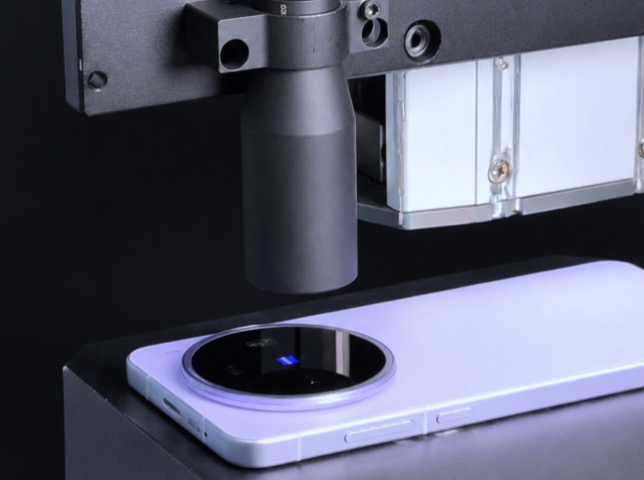
Step Height Detection in Smartphone Camera Modules Using Spectral Confocal Metrology
To maintain visual consistency and waterproof sealing in mobile device assembly, manufacturers use the SinceVision SCI04025 spectral confocal displacement sensor for smartphone camera module step height detection.
 Product Inquiry
The height difference between a smartphone camera module and the rear cover directly determines visual consistency and mechanical assembly quality. Excessive or uneven step heights introduce structural alignment deviations and compromise waterproof sealing quality control, leading to higher rework rates and increased manufacturing costs.
To meet precision assembly tolerances, SinceVision deploys the SCI04025 spectral confocal displacement sensor for non-contact step height measurement. By simultaneously capturing height contours across both the back cover reference plane and the camera module, the system delivers reliable quantitative data for automated inline verification.
Metrology Challenges on Smartphone Assemblies
Inspecting the interface between a camera housing and a smartphone back cover presents distinct optical obstacles that cause conventional laser triangulation sensors to fail:
Mixed Surface Reflectivity: The smartphone rear cover and the camera module bezel or lens glass exhibit vastly different reflective properties, causing abrupt signal fluctuations.
Curved Edge Geometry: Steep chamfers and curved edges around the camera module deflect standard optical beams away from the receiver, resulting in unstable signals and data dropouts.
Cosmetic Scratch Vulnerability: Mechanical contact probes risk scratching anti-reflective lens coatings and polished exterior glass, creating direct yield loss.
How the SCI04025 Resolves Complex Surface Contours
By scanning across the inspection zone, the SCI04025 uses coaxial polychromatic light to focus distinct wavelengths at different vertical distances. Because the measurement axis aligns coaxially with the optical path, the sensor stably captures contour data on curved and reflective surfaces, including mirror-like metals and transparent glass. The system then computes the exact step height directly from the vertical profile difference between the rear cover reference surface and the camera module.
Technical Specifications and Engineering Value
| Parameter | SCI04025 Specification | Engineering Benefit for Camera Assembly |
| Working Distance | 16 mm | Provides safe mechanical clearance above assembled smartphone frames. |
| Linearity | ±0.8 μm | Detects micron-level height deviations to enforce tight assembly tolerances. |
| Angular Range | ±25° | Maintains stable signal return across beveled edges and curved camera bezels. |
| Min. Transparent Thickness | 130 μm | Supports single-sided thickness and surface profiling on thin protective lens glass. |
Image: Smartphone Camera Module Step Height Detection
Core Advantages for Consumer Electronics Production
High-Precision Measurement: Linearity of ±0.8 μm reliably isolates minute height variations before devices move to final sealing and packaging.
Strong Tilt Adaptability: A ±25° angular tolerance accommodates angled housings and curved edges without losing contour continuity.
Scratch-Free Non-Contact Detection: Purely optical measurement protects delicate lens glass and cosmetic rear covers from mechanical wear or surface defects.
Transparent Material Compatibility: With a minimum measurable thickness of 130 μm, the sensor handles transparent material measurement alongside opaque metal and glass substrates in a single scan.
Frequently Asked Questions (FAQ)
1. Why is step height detection critical for smartphone camera module assembly?
Step height directly governs both exterior cosmetic uniformity and structural sealing. If the height difference between the camera module and the rear cover falls outside tolerance, adhesive seals and gaskets fail to compress evenly, which compromises waterproof integrity and increases assembly rework.
2. Why use a spectral confocal sensor instead of a standard laser sensor for camera module inspection?
Smartphone assemblies combine contrasting materials, such as matte or glossy rear glass, metallic camera bezels, and curved edges. Standard laser triangulation sensors suffer from secondary reflections and shadowing on steep angles. A spectral confocal sensor like the SinceVision SCI04025 uses coaxial optics and a ±25° angular range to capture stable height data across reflective, mirror-like, and curved contours.
3. Can the SinceVision SCI04025 inspect transparent camera lens glass?
Yes. The SCI04025 detects both the top and bottom surfaces of transparent materials down to a minimum measurable thickness of 130 μm, enabling simultaneous step height verification and transparent layer metrology without physical contact.







 Compare
 Clear the comparison bar

