










Research Published in Nature Communications: SinceVision Camera Validates New Neuromorphic Imaging Array
A research team at the University of Chinese Academy of Sciences used the SinceVision SH3-101 high speed camera as an independent reference device to validate a new lead-free perovskite neuromorphic imaging array and by published in Nature Communications.


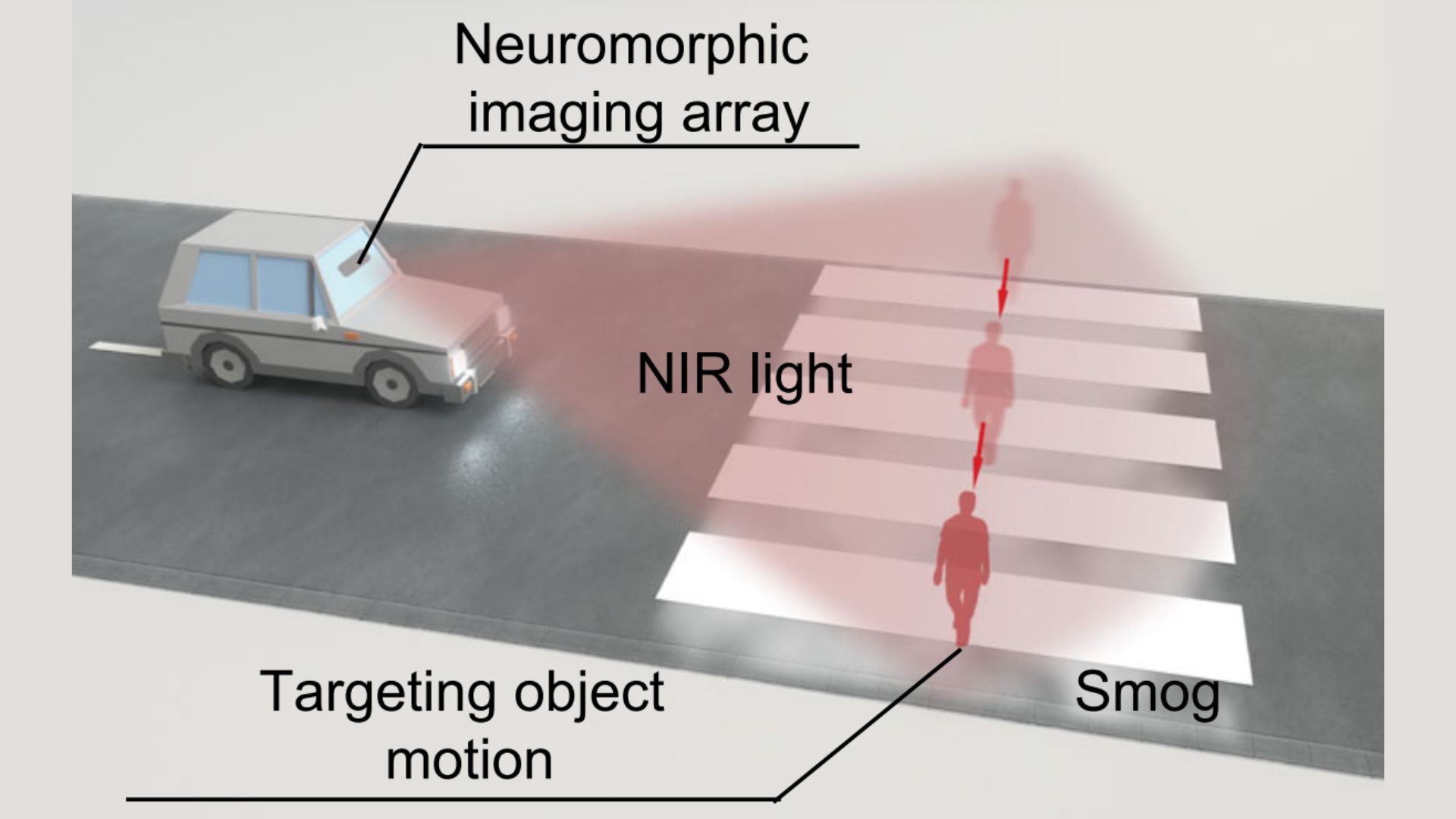
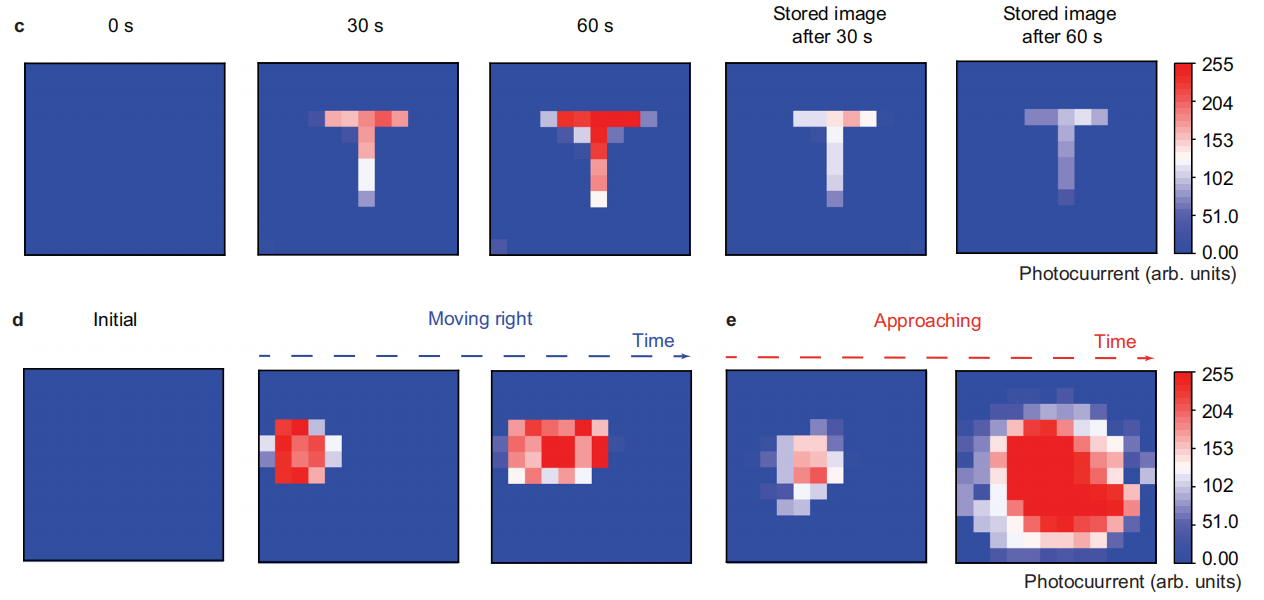
Recently, a joint research team led by the University of Chinese Academy of Sciences successfully overcame the inherent instability of tin-based perovskites caused by the easy oxidation of Sn²⁺ and high defect density. For the first time, they demonstrated a near-infrared neuromorphic imaging array based on lead-free perovskites, achieving spatiotemporal fusion and motion detection capabilities at the hardware level.
The SinceVision SH3-101 high-speed camera, serves as a reference calibration device, provides a critical means of validation for the practical application of integrated sensing and computing smart vision chips. The relevant findings have been published in the top-tier international journal “Nature Communications”.
Source: Liu, T., Yuan, Z., Wang, L. et al.
1. The Challenge of Traditional Image Sensors
Most image sensors used today separate the tasks of seeing, storing, and computing. A camera captures light. A memory chip stores the image. A processor analyzes it. For applications like autonomous driving, moving data back and forth between these three parts wastes energy and creates delays.
Researchers have been looking for a better way. They are designing sensors inspired by human biology. These new devices, called neuromorphic imaging arrays, combine light sensing and basic computation on a single chip. This approach uses less power and processes visual information much faster.
2. A Breakthrough in Lead Free Perovskite
A collaborative research team spanning multiple institutions recently achieved a major step forward in this area. The work was led by Tianhua Liu and Ziquan Yuan, who contributed equally to the research. The project was supervised by corresponding authors Professor Xiangyue Meng at the University of Chinese Academy of Sciences and Professor Yang Chai at The Hong Kong Polytechnic University.
The team successfully built a near infrared imaging array using a lead free material known as tin based perovskite. Working with tin perovskite has historically been difficult because the material is unstable and degrades quickly. The researchers solved this problem by adding a natural molecule called quercetin. This process stabilized the material and made the array practical to use. The complete findings were published in the journal Nature Communications (DOI: 10.1038/s41467-025-59624-2).
3. The Role of the SinceVision SH3-101 High Speed Camera
While the new array could detect motion, the team faced a verification problem. The array itself has a low resolution of just 12 by 12 pixels. The researchers could see that the array was sensing movement, but they could not prove the movement data was exactly correct. They needed an independent witness to provide "ground truth."
This is where the SinceVision SH3-101 high speed camera became essential.
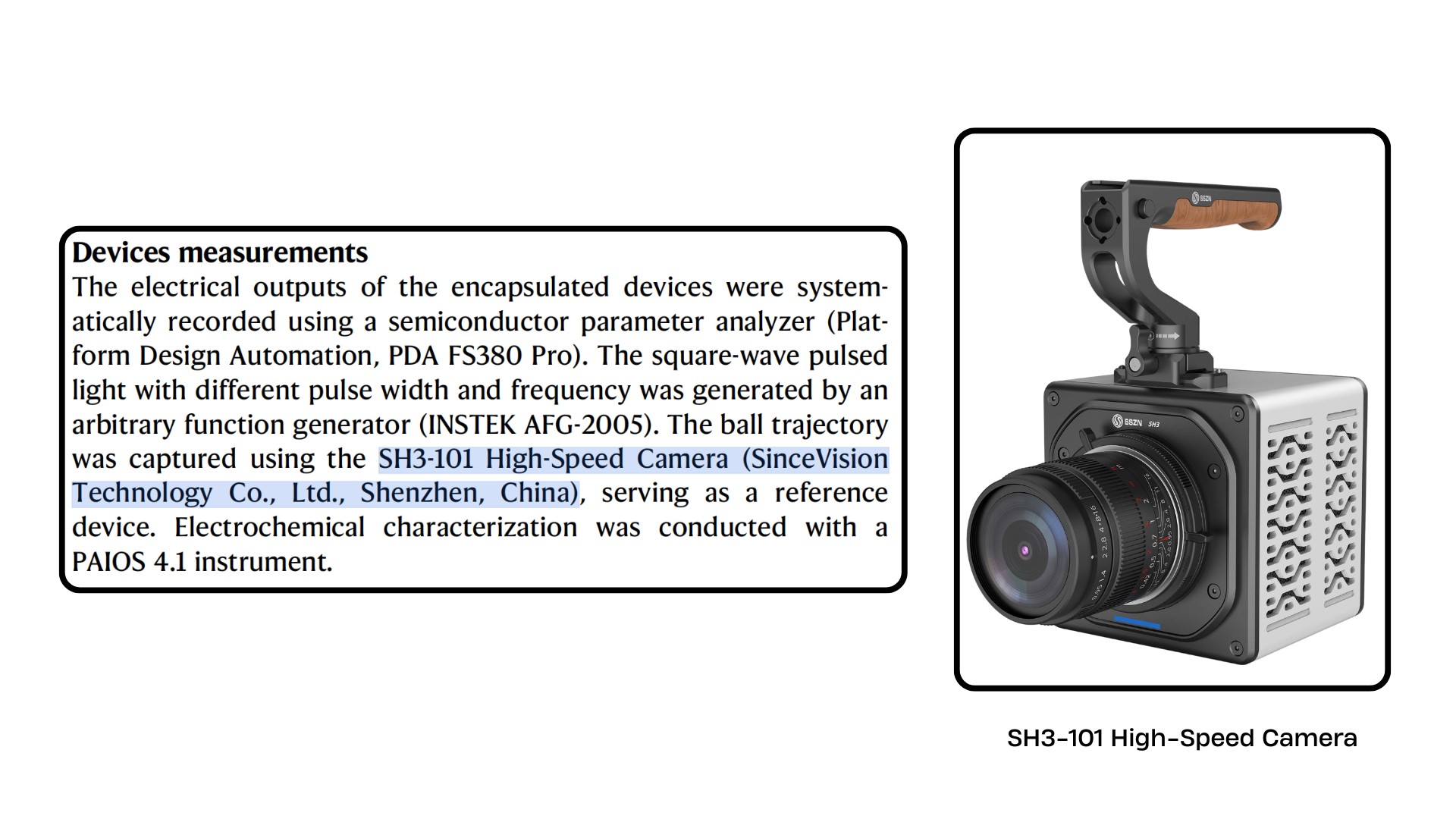
The team mounted the SH3-101 camera to record the physical movement of a light spot in real time. The camera captured the scene at 1000 frames per second with a high resolution of 1280 by 1024 pixels. This optical recording was completely separate from the electrical signals coming from the new perovskite chip. SH3-101 high-speed camera features 4TB of real-time storage, enabling the complete recording of critical image data.
By comparing the camera's visual record against the array's electrical heatmap, the researchers could answer three critical questions:
Did the length of the trail in the heatmap match the actual path of the light?
Did the direction of the sensor signal align with true physical motion?
Was the device remembering motion, or was the material simply degrading?
As noted in the study's methodology: "The ball trajectory was captured using the SH3-101 High Speed Camera (SinceVision Technology Co., Ltd., Shenzhen, China), serving as a reference device." This comparison proved that the new lead free perovskite array accurately perceived lateral movement and depth changes for the first time at the hardware level.
4. From Validation Tool to Core Discovery Method
This study highlights a broader role for high speed cameras in scientific research. The SH3-101 was not just taking pictures. It was providing a reliable optical reference that electrical testing equipment could not offer.
Source: Liu, T., Yuan, Z., Wang, L. et al.
For researchers developing next generation sensors, an independent visual record is often the only way to confirm that a device is truly "seeing" correctly. The camera transforms fast, invisible processes into clear data points that can be measured and compared. This allows scientists to distinguish between a genuine technical breakthrough and a false signal caused by material defects.
Source Citation:
Liu, T., Yuan, Z., Wang, L. et al. Chelated tin halide perovskite for near infrared neuromorphic imaging array enabling object recognition and motion perception. Nat Commun 16, 4261 (2025).
https://doi.org/10.1038/s41467-025-59624-2
If you are facing challenges in observing and validating high speed transient events, please contact our team to discuss a customized solution for your laboratory.

Featured Camera

SH3-101
You can also read
SinceVision Launches SH8 Series 1.1 million FPS Ultra-High-Speed Camera at VISION 2026
Oct 07, 2026
SinceVision Launches SRI6000 Series Embedded Vision 3D Laser Profilers at VISION 2026
Oct 06, 2026
SinceVision at VISION 2026: A Complete Recap of Our Product Launches and Strategic Partnerships
Oct 13, 2026
How SinceVision High-Speed Cameras Power Electrospinning Research at Zhejiang Sci-Tech University (ZSTU)
Jul 01, 2026
SinceVision's New SD33-300 and SD33-600: Long-Range Laser Displacement Sensors for Wide-Span Precision Measurement
May 09, 2026



 Compare
 Clear the comparison bar
