










How SinceVision High-Speed Cameras Power Electrospinning Research at Zhejiang Sci-Tech University (ZSTU)
Researchers at Zhejiang Sci-Tech University utilized the SinceVision SH6-109 high-speed camera to analyze millisecond jet splitting during electrospinning. Published in Separation and Purification Technology, the study demonstrates how high-speed visual data enables precise structural control of bimodal fibers, achieving 99.974% air filtration efficiency.
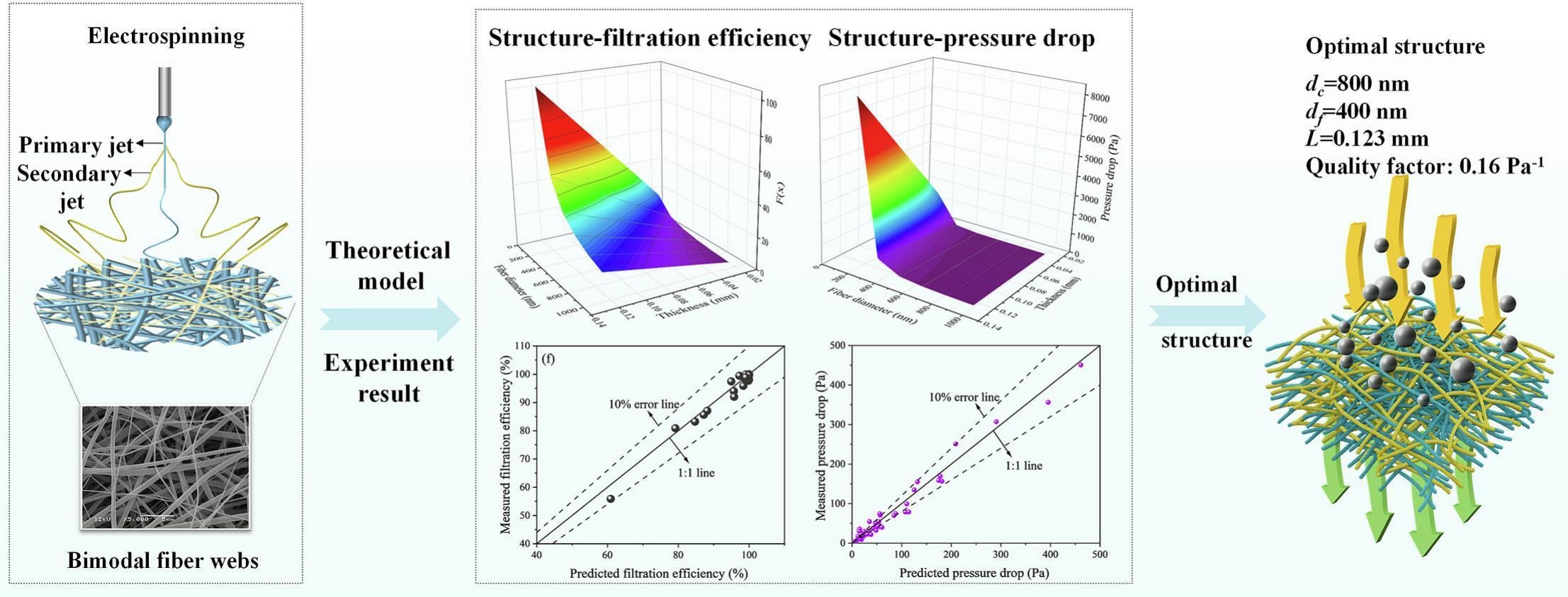


This article highlights recent breakthroughs made possible by SinceVision high-speed imaging technology, as detailed in the following peer-reviewed publication:
Paper Title: Single-nozzle electrospinning of bimodal fibers for ultralow-pressure-drop air filtration: Synergistic structure-performance optimization
Authors: Zongzi Hou, Huashuai Cui, Zetian Zhang, Jintang Zhu, Ning Cui, Xianning Shi, Yongming Shi, Qing Huang, Pengfei Wu, Bin Yu
Affiliations: College of Textile Science and Engineering (International Institute of Silk), Zhejiang Sci-Tech University & State Key Laboratory of Bio-based Fiber Materials, China Textile Academy
Journal: Separation and Purification Technology (Volume 386, 2026, 136562, ISSN 1383-5866)
Supported by: National Key Research and Development Program of China
1. Experimental Background
Electrospinning is one of the core technologies for preparing high-performance air filtration fiber membranes. In the preparation of bimodal fibers (fibers of varying diameters), the splitting behavior of the jet under high voltage directly determines the fiber diameter distribution, which in turn affects filtration efficiency and pressure drop.
However, jet splitting occurs on a millisecond timescale, and traditional observation methods are unable to capture its transient behavior. This has resulted in a long-standing reliance on a “trial-and-error” approach for controlling fiber structure. Most existing studies infer jet behavior by analyzing final SEM images, lacking direct evidence of the jet's morphological evolution, the timing of primary and secondary jet formation, and the quantitative relationship between the degree of splitting and process parameters. This limitation has hindered the rational design and industrialization of bimodal fibers.
To solve this, the SinceVision SH6-109-M-40-12T high-speed camera was introduced into this study as the core observation device. It performed continuous high-speed imaging of the electrospinning jet behavior, providing visual evidence for fiber structure control. The relevant research findings were published in the International Journal Separation and Purification Technology.

Image: Screenshot from the journal
2. Experimental Methods
2.1. Experimental System
The research team established a comprehensive experimental platform comprising an electrospinning apparatus (ET-2535x), a high-voltage power supply, a solution injection system, a rotating drum collection device, and a high-speed camera system.
The core component was the SH6-109-M-40-12T high-speed camera, independently developed by SinceVision, featuring a resolution of 1280×1024 and a maximum frame rate of 9,500 fps. During the experiments, the SinceVision high-speed camera continuously recorded the morphology of electrospinning jets under different solution concentrations (6–14 wt%) and voltages (20 kV / 32 kV). These observations were correlated with process parameters such as spinning time and solution flow rate to ensure a strict correlation between jet behavior and the final fiber diameter distribution.
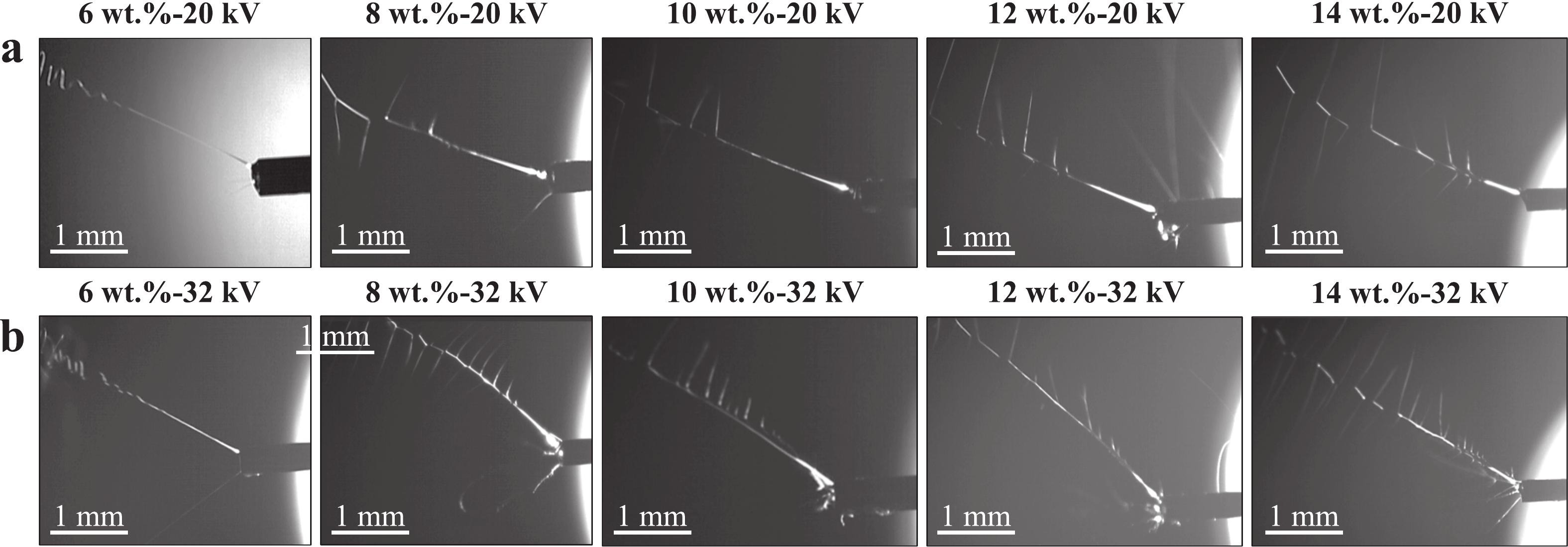
Fig. 1. Spinning behavior of precursor solutions with concentrations of 6–14 wt% under 20 kV (a) and 32 kV (b).
2.2. Experimental Procedure
The experiment was designed with multiple sets of operating conditions:
Solution concentrations: 6 wt%, 8 wt%, 10 wt%, 12 wt%, 14 wt%
Applied voltages: 20 kV, 32 kV
A scanning electron microscope (SEM) was used to observe the morphology of the fiber web, and ImageJ software was employed to measure the fiber diameter distribution. By combining these results with jet behavior captured by the high-speed camera, a mapping relationship between “jet mode → fiber distribution” was established.
3. Experimental Data
3.1. Capturing the Transient Evolution of Jet Splitting
The jet evolution process captured by the SinceVision SH6-109-M-40-12T provided a high-temporal-resolution image sequence demonstrating the bimodal fiber formation mechanism, aiding researchers in the visual analysis of jet splitting behavior. The jet images cover multiple sets of typical experimental results under different solution concentrations and voltage conditions. (Insert Figure Here)
3.2. Quantitative Analysis of Fiber Distribution
Using images captured by the SinceVision camera, combined with SEM fiber diameter statistics, the bimodal index R (coarse fiber diameter / fine fiber diameter) was determined under different operating conditions:
At 20 kV voltage: A 6 wt% concentration exhibits a stable single jet. As the concentration increases to 8–14 wt%, the main jet gradually splits laterally, forming multiple secondary jets. The degree of splitting intensifies as the concentration rises. From 6 wt% to 14 wt%, the bimodal index R increases from 1 (single peak) to 2.99 (a distinct bimodal distribution).
At 32 kV voltage: The enhanced electric field caused the main jet and secondary jets to stretch more uniformly. A distinct bimodal distribution appeared only at a concentration of 14 wt% (R = 2.11).
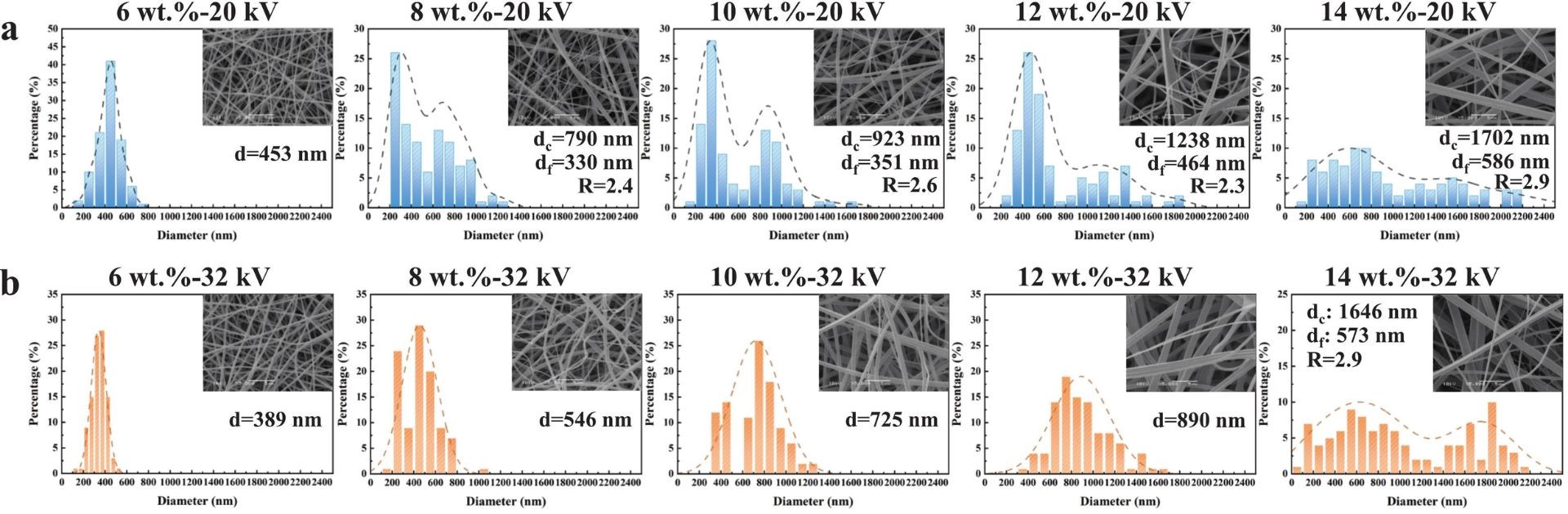
Fig. 2. SEM images and fiber diameter distribution of electrospun fiber webs prepared from precursor solutions with concentrations of 6–14 wt% under applied voltages of 20 kV (a) and 32 kV (b).
Based on the jet evolution process, two typical modes of electrospinning jets were identified:
Single-jet mode: The jet is smooth and unbranched, resulting in a unimodal distribution of final fibers.
Split-jet mode: The main jet splits into multiple secondary jets, resulting in a bimodal distribution of final fibers (both thick and thin fibers present).
The SinceVision high-speed camera revealed the phased characteristics of jet splitting and established a direct link between process parameters, jet modes, and fiber distribution.
3.3. Response Characteristics of Filtration Performance
Based on the process optimization, the research team prepared bimodal fiber mats with different structures and tested their filtration performance.
Under the optimal structure (coarse fibers: 800 nm; fine fibers: 400 nm; thickness: 0.123 mm), the filtration efficiency reached 99.974% with a pressure drop of only 54.4 Pa. This setup achieved a QF of 0.16 Pa−1, demonstrating excellent overall air filtration performance.
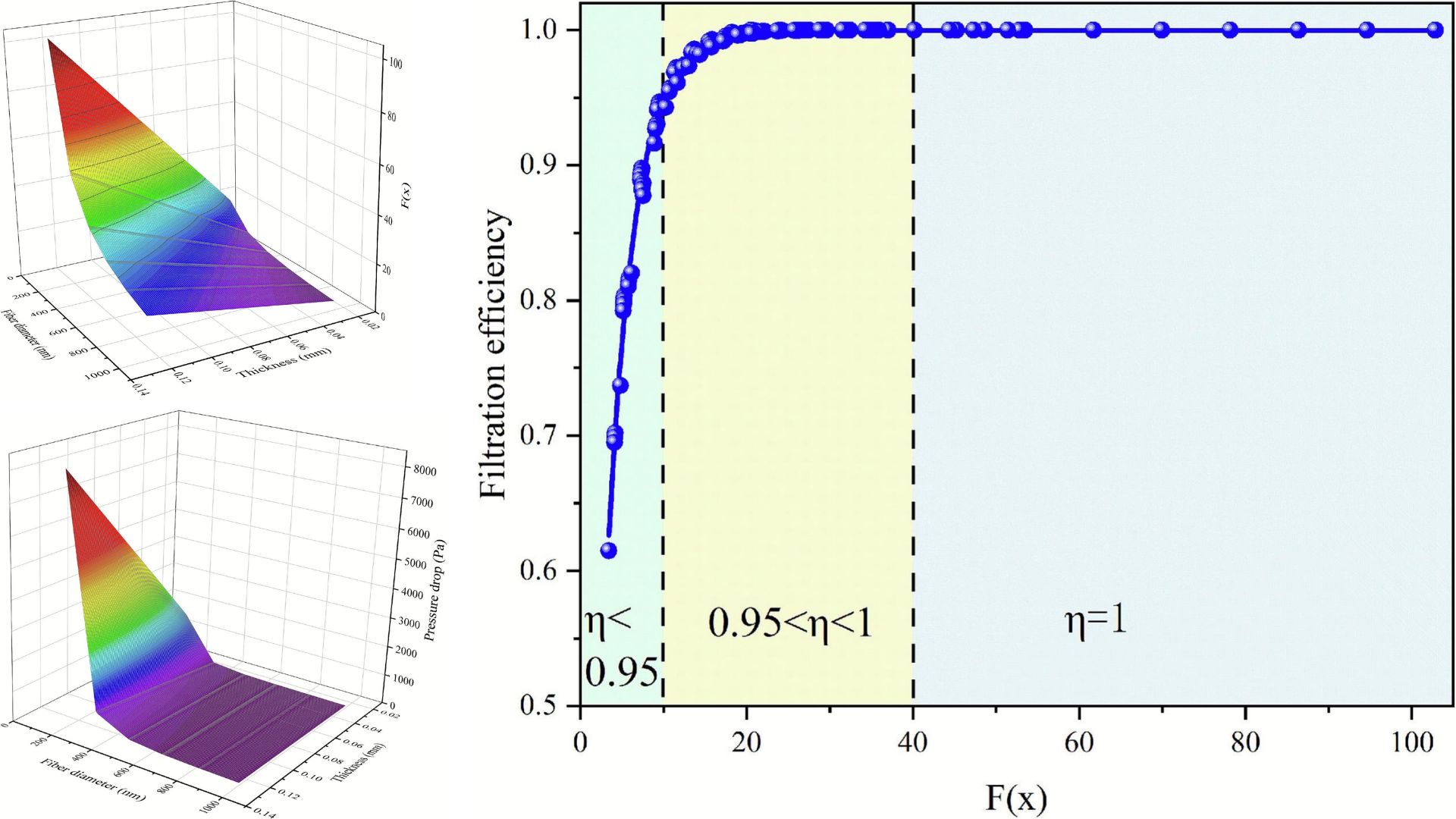
Fig: 10, 11, 12 shows the relationship between different fiber diameters, fiber thicknesses, air resistance, and filtration efficiency.
4. Experimental Conclusions
By integrating high-speed cinematography experiments with multi-parameter coupled analysis, this study revealed the intrinsic relationship between jet splitting behavior and the formation of bimodal fibers:
Visual Mechanism Confirmation: The SinceVision SH6-109-M-40-12T comprehensively recorded the evolution of the electrospinning jet from a stable single-strand state to the formation of secondary jets. This clearly revealed that the main jet maintains a coarse diameter while secondary jets form a fine diameter, establishing a chain of evidence linking “process parameters → jet patterns → fiber distribution.”
Parameter Control: The degree of jet splitting increases with rising solution concentration. Under 20 kV and 14 wt%, the bimodal index R reached 2.99. Under a strong electric field of 32 kV, splitting was suppressed, and bimodal characteristics appeared only at extreme concentrations.
Optimal Fabrication: Guided by camera observations, fiber structure optimization led to the successful fabrication of a high-performance bimodal fiber web with a filtration efficiency >99.97%, a pressure drop <55 Pa, and a quality factor of 0.152 Pa⁻¹.
When millisecond-scale jet splitting behavior is clearly captured, the long-standing problem of “invisibility” is resolved, driving the broader application of high-speed cameras in scientific research and industrial settings. SinceVision high-speed cameras not only serve as a vital observation tool for the electrospinning process but also provide critical visual data for analyzing jet dynamics and precisely controlling fiber diameter distribution.
Capturing the Invisible: SH6-109 High-Speed Camera
The electrospinning jet evolution was captured using the SinceVision SH6-109, an ultra-high-speed camera engineered for advanced scientific research and materials science. Capable of reaching a maximum shooting speed of 750,000 frames per second with a minimum exposure time of just 100ns, the SH6-109 easily freezes transient, millisecond-scale phenomena like rapid jet splitting.
The camera features a large 14.6μm pixel size for superior light sensitivity and operates on a robust 100Gbps data bandwidth to handle massive image sequences. With standard memory options up to 320GB and expandable storage up to 24TB, the SH6-109 provides the sustained recording capabilities required for high-end applications across fluid mechanics, advanced manufacturing, and complex chemical processes.
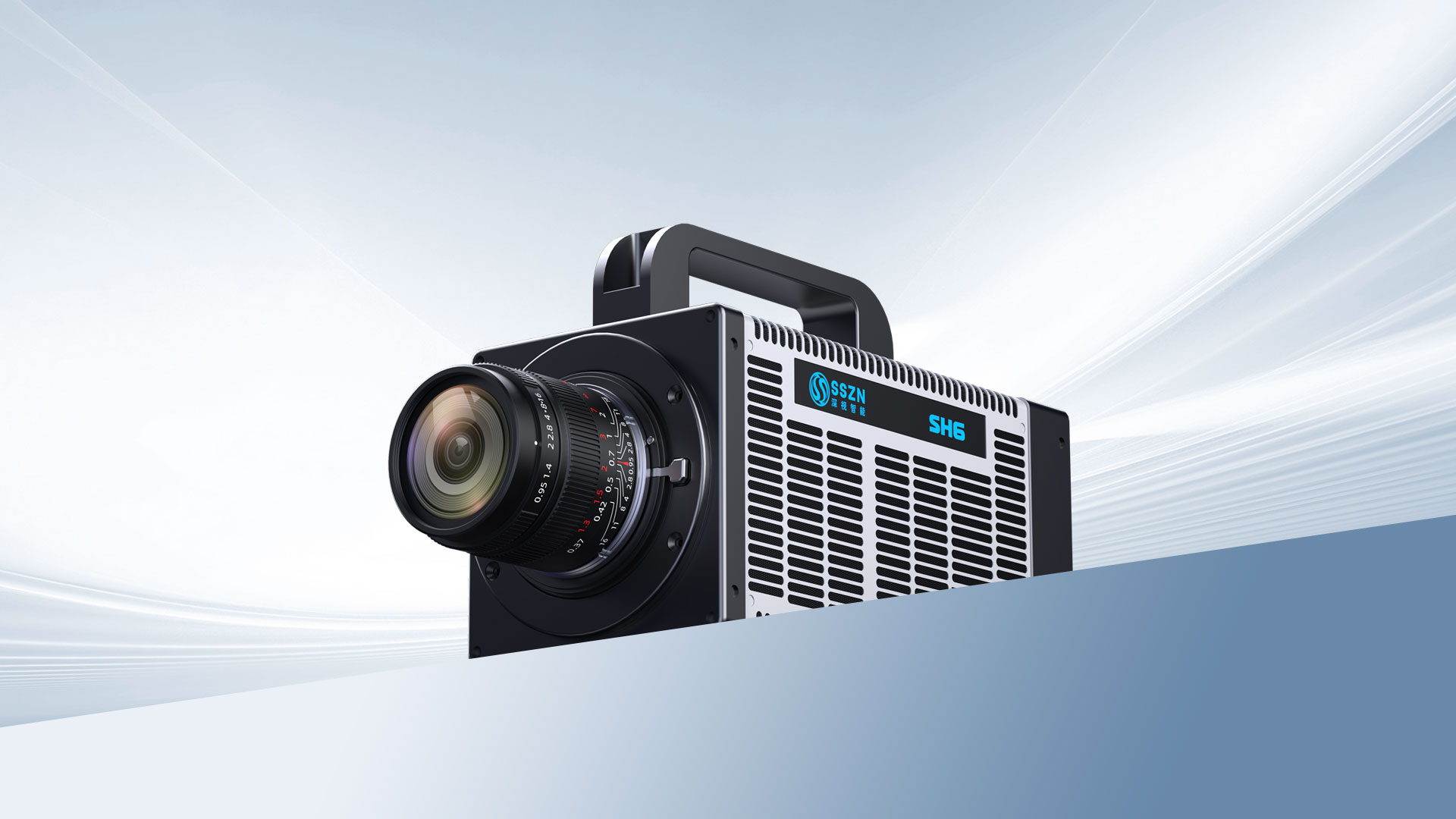
Image: SH6-109 High-Speed Camera

Featured Camera

SH6-109
You can also read
How SinceVision High-Speed Cameras Power Electrospinning Research at Zhejiang Sci-Tech University (ZSTU)
Jul 01, 2026
SinceVision's New SD33-300 and SD33-600: Long-Range Laser Displacement Sensors for Wide-Span Precision Measurement
May 09, 2026
Research Published in Nature Communications: SinceVision Camera Validates New Neuromorphic Imaging Array
Apr 22, 2026
SinceVision and Lunitek Announce Partnership to Advance Scientific Discovery in Italy
Apr 21, 2026
SinceVision Launches New Back-Illuminated Cooled sCMOS Camera Series for Ultra-Low-Light Scientific Imaging
Nov 17, 2025



 Compare
 Clear the comparison bar
