










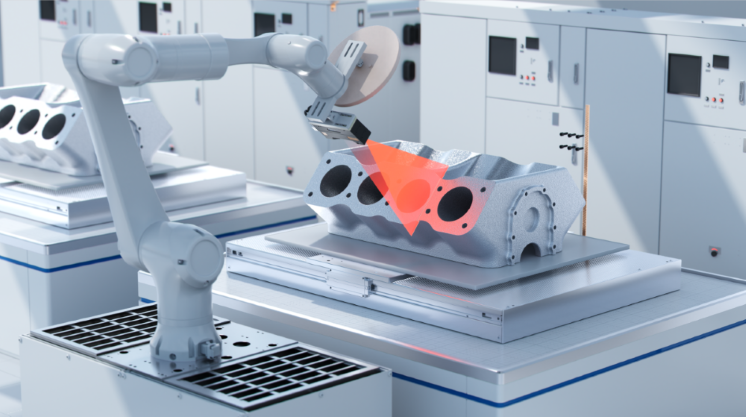
Accurate Polishing Path Planning for Large Engine Castings
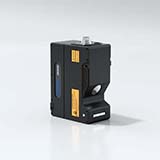
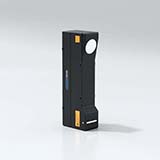
SinceVision's SRI Series 3D Laser Profiler restores the surface geometry of large engine castings by capturing point cloud data in real time. The system uses a 650 nm red light wavelength for reliable imaging of dark casting surfaces and completes full surface detection in 1.5 seconds at 720 mm per second scanning speed. This data drives accurate polishing path planning for the grinding machine, improving efficiency and consistency across variable casting batches in automotive powertrain production.
 Product Inquiry
Related tags
Challenges
Large engine castings come out of the foundry with burrs, surface irregularities, and material excess that need to be ground down before assembly. Doing this manually is slow and inconsistent. Automating it without accurate surface data is equally problematic — a grinding machine running a fixed path cannot account for the natural variation between individual castings, leading to over-grinding in some areas and missed defects in others.
The core problem is surface reconstruction. Before any grinding path can be planned, the system needs to know exactly what the surface looks like right now, not what the CAD model says it should look like.
Solutions
SinceVision's SRI Series Integrated 3D laser profiler captures point cloud data from the casting surface, giving the vision system a true, real-time reconstruction of the object's current state. The algorithm uses this data to plan the precise polishing path the grinding machine needs to follow, accounting for actual burr location, defect distribution, and surface geometry on that specific part.
The result is a grinding process that adapts to each casting rather than assuming uniformity that does not exist on the production floor.
Why It Works
Effective imaging on dark surfaces. The SRI series uses a 650 nm red light wavelength, which makes it significantly easier to image black or dark-colored casting surfaces where shorter wavelengths produce poor contrast and unreliable point cloud data.
Fast enough for production. At a scanning speed of 720 mm per second, the full surface detection completes in 1.5 seconds, keeping pace with production throughput without creating an inspection bottleneck.
Production Impact
Consistent polishing quality across large casting batches is difficult to achieve without accurate surface feedback at the individual part level. The SRI series sensor closes that gap by giving the grinding system real geometry to work with, improving both polishing efficiency and surface consistency across every part that moves through the line.
Talk to SinceVision Experts
If your operation involves grinding or polishing of cast components with variable surface conditions, the SinceVision engineering team can assess your application. Contact us to request a technical consultation or sample trial.
Explore the full automotive cases here: Powertrain Fuel System Quality Control and 16 Key Inspection Scenarios from Parts to Complete Vehicles






 Compare
 Clear the comparison bar
