










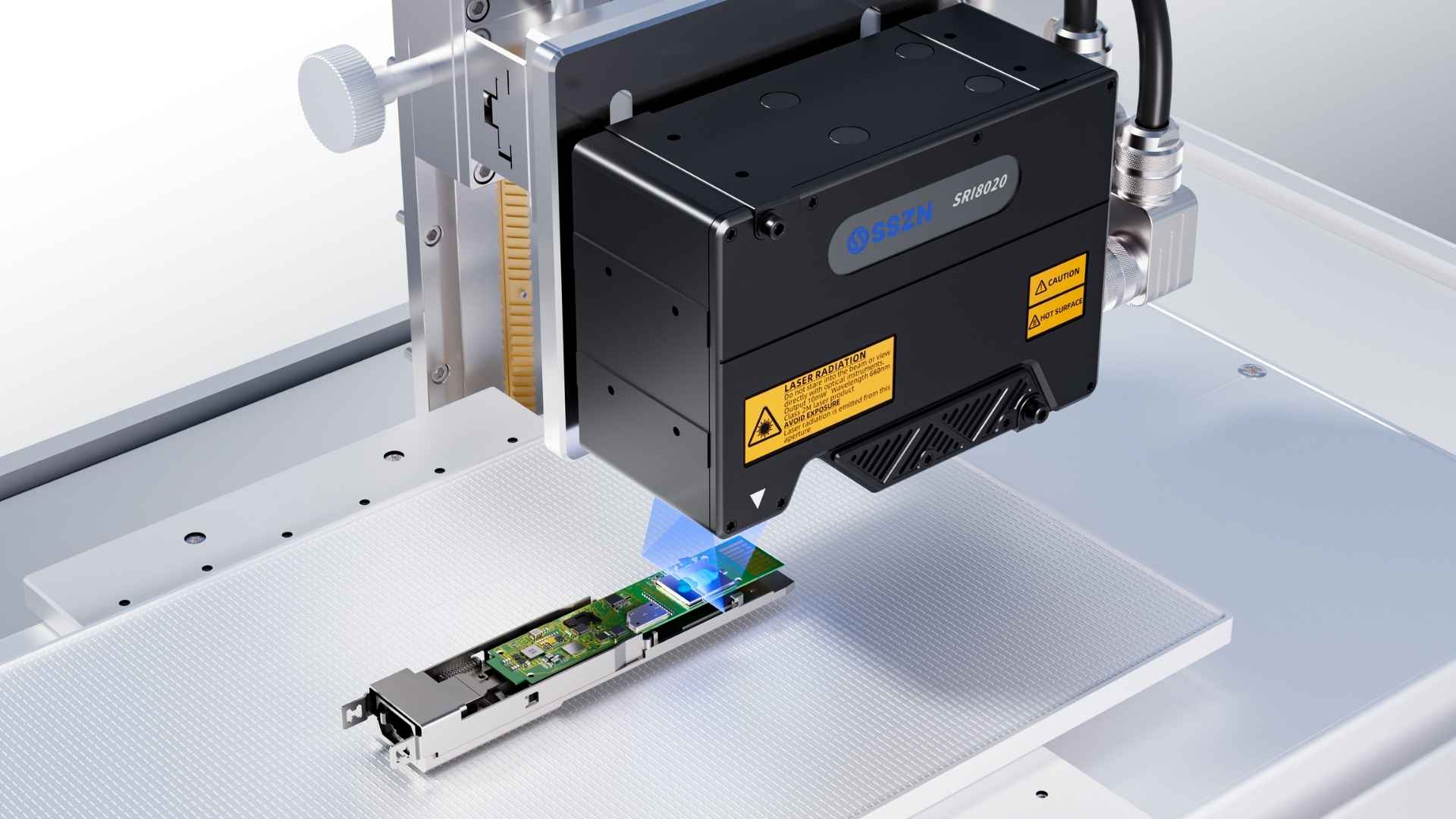
Inspecting Adhesive Dispensing in AI Servers
In optical module assembly for AI servers, adhesive volume and height directly dictate thermal management and signal integrity. The SinceVision SRI series integrated 3d laser profiler delivers non contact dimensional inspection, capturing critical Z axis topography where conventional methods fail. By utilizing high performance 3d sensors, this laser profiler controls adhesive height deviations to less than 4 μm across transparent, dark, and reflective bonding materials. The system provides the micrometer level dispensing verification required to eliminate assembly defects in automated 3d laser profiler inspection workflows.
 Product Inquiry
Related tags
Executive Summary
Challenges: AI servers rely on highly compact optical modules for high speed data communication. The precise height, shape, and distribution of dispensed adhesive directly dictate the thermal management and long term reliability of these modules.
Solution: Integrating the SinceVision SRI series 3D laser profiler provides non contact, high precision dimensional scanning of the dispensed adhesive.
Key Specifications: The system captures dense 3D geometry and controls adhesive height deviations to less than 4 μm.
Engineering Impact: Utilizing advanced 3D sensors ensures micrometer level assembly precision, eliminates contact induced component damage, and delivers stable imaging across various reflective bonding materials.
The Engineering Challenge: Adhesive Dispensing in AI Servers
As core components for high speed communication in AI servers, optical modules feature extremely compact, high density designs. During the component assembly phase, applying adhesive correctly is a critical manufacturing process. The exact height, 3D geometry, and volume distribution of this adhesive directly affect the structural integrity and long term operational reliability of the equipment.
If adhesive dispensing is uneven or height deviations occur, it can lead to component misalignment, poor heat dissipation, and ultimately, optical signal attenuation. Therefore, manufacturers require high precision testing of the adhesive dispensing process to guarantee stringent assembly quality before the optical modules are permanently sealed.
Solution: SRI Series Integrated 3D Laser Profiler
To address these strict assembly tolerances, packaging lines integrate the SinceVision SRI series 3D laser profiler. Utilizing advanced non contact 3D scanning technology, this sensor performs high precision inspection of the adhesive within the optical module.
The SRI series captures dense 3D point clouds to calculate the exact geometry and height of the applied adhesive. It controls height deviations to less than 4 μm, easily meeting the strict requirements for high precision assembly in AI hardware manufacturing. Furthermore, the SRI series features a highly integrated PCBA design that eliminates the need for a bulky external controller, making it ideal for the spatial constraints of automated production lines.
Core Advantages of the SRI Series
Micrometer Level Precision Inspection: The 3D laser profiler accurately captures absolute 3D geometry and adhesive height data. This guarantees that the dispensing process meets the high reliability thresholds required for modern AI servers.
Broad Material Compatibility: Inspecting wet or reflective glues is traditionally difficult for standard vision systems. The SRI series features highly stable imaging algorithms that deliver reliable test results across adhesives of different materials, colors, and reflectivity characteristics.
Non Contact Measurement: By utilizing optical 3D sensors, the system prevents any contact induced damage to fragile optical modules. It operates continuously, making it perfectly suited for high speed inline inspection on automated assembly lines.
Technology Comparison: Adhesive Inspection Methods
| Inspection Method | Measurement Principle | Accuracy | Material Compatibility | Line Integration |
| Manual or 2D Camera | Visual contrast and 2D area calculation | Low (cannot measure absolute height) | Poor (struggles with clear or reflective adhesives) | Complex lighting required |
| SinceVision SRI Series 3D Laser Profiler | Non contact optical 3D triangulation | High (<4 μm height deviation control) | Excellent (stable imaging across clear, dark, or reflective glues) | High (integrated design, no external controller) |
Frequently Asked Questions (FAQs)
Why are 3D sensors necessary for optical module adhesive inspection?
Traditional 2D cameras can only see the X and Y dimensions to calculate area and shape. They cannot measure the Z-axis height. 3D sensors, specifically a 3D laser profiler, generate a complete topographical map to measure exact adhesive volume and height. This ensures the glue does not overflow or sit too low, which is critical for the thermal stability of AI servers.
How does the SinceVision SRI series handle reflective or transparent adhesives?
The SRI series uses advanced imaging algorithms and high power laser configurations to suppress ambient light and stabilize reflections.
What does an integrated 3D laser profiler mean?
Many industrial laser profilers require a bulky external controller to process the heavy data loads of 3D point clouds. The SinceVision SRI series features an integrated PCBA design where all processing happens inside the sensor head itself.






 Compare
 Clear the comparison bar
