










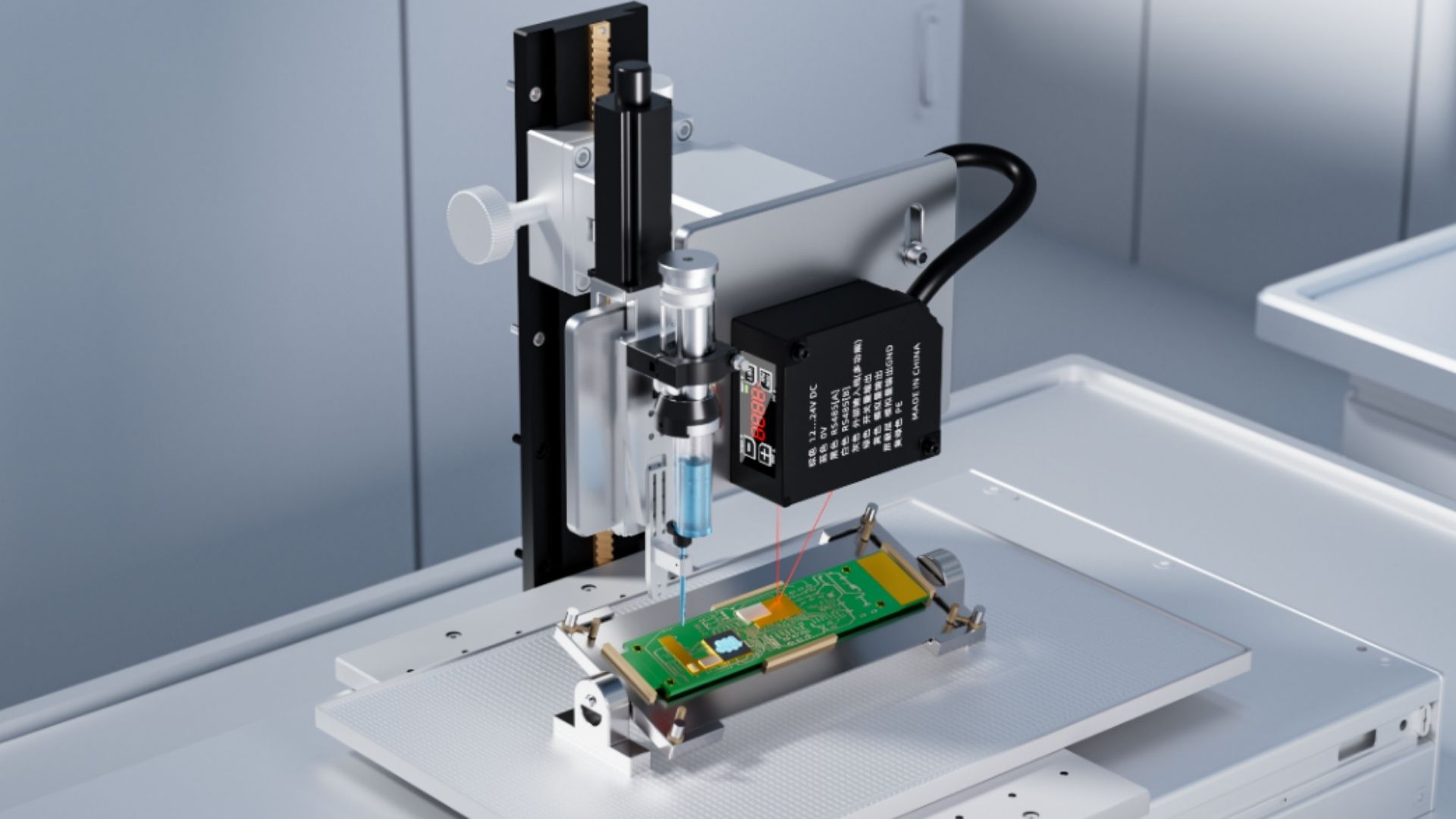
Enhancing PCBA Quality in AI Hardware Manufacturing
SinceVision SD33-30 laser displacement sensor provides real time high precision dispensing guidance for AI server PCBA manufacturing. Operating at a 3 kHz sampling frequency with 2 micron repeatability, the compact sensor measures microscopic surface height variations without contact. This spatial data enables dynamic dispensing valve adjustment, ensuring uniform adhesive application on optical modules and improving overall automation efficiency for AI hardware.
 Product Inquiry
Executive Summary
Challenges: Optical modules in AI computing servers require precise adhesive application on printed circuit board assembly (PCBA) surfaces. Fixed height dispensing causes uneven bonding due to microscopic surface variations.
Solution: Integrating the SinceVision SD33-30 laser displacement sensor provides real time height measurement to guide the dispensing valve automatically.
Key Specifications: 3kHz sampling frequency, 30 mm reference distance, and ±0.1% full scale linearity.
Result: Consistent adhesive layers, improved production speed, and seamless integration into compact AI server assembly lines.
Background: The PCBA Dispensing Challenge in AI Servers
Quality control in AI hardware manufacturing leaves zero room for error. Optical modules within AI computing servers rely on precise PCBA processes. During manufacturing, applying adhesive correctly is a critical step that dictates the lifespan and reliability of the hardware.
The dispensing height directly determines the adhesive thickness and the final bonding strength. However, PCBA surfaces inevitably have slight height variations. If production equipment applies adhesive at a static fixed height, these surface variations cause uneven adhesive distribution. This leads to weak bonds and potential component failure. Therefore, manufacturers must measure component height precisely before applying any adhesive.
Solution: Real Time Dispensing Guidance
To solve the variable height problem, manufacturers mount a SinceVision SD33-30 laser displacement sensor directly beside the dispensing valve. This configuration allows the system to measure the surface height of the PCBA in real time just milliseconds before the adhesive drops.
The sensor operates at a sampling frequency of 3kHz. It features a reference distance of 30mm and a measurement range of ±4mm. With a linearity of ±0.1% of the full scale, the device captures the exact topography of the board. This specific footprint makes it highly suitable for high precision inspection tasks where machinery space is strictly limited.
Operational Advantages
Guaranteed Adhesive Consistency
The laser displacement sensor quickly detects minute height variations on the PCBA surface. It sends precise spatial data to the dispensing system to adjust the valve height dynamically. This continuous adjustment ensures a perfectly consistent adhesive layer across every single board.
High Speed Automated Inspection
Because the measurement is entirely non contact, it does not slow down the assembly line. The sensor integrates directly with the dispensing equipment control system. This hardware integration allows the machinery to inspect, decide, and compensate simultaneously. The result is a higher automation level and increased production efficiency for the entire dispensing process.
Flexible Integration for Complex Surfaces
AI hardware manufacturing involves highly miniaturized and complex components. The SD33-30 sensor features a compact design that fits easily into existing dispensing machinery. It adapts seamlessly to the strict layout constraints required by modern AI computing server production lines.
Frequently Asked Questions (FAQs)
What is the role of a laser displacement sensor in PCBA manufacturing?
A laser displacement sensor measures the exact distance to a target surface without physically touching it. In PCBA manufacturing, it measures the microscopic height variations of the circuit board so the dispensing equipment can adjust its nozzle height, ensuring a uniform application of adhesive.
Why is fixed height dispensing a problem for AI hardware manufacturing?
AI server components are highly sensitive. Even a fraction of a millimeter variance on a PCBA surface can cause a fixed height dispensing valve to apply too much or too little adhesive. This results in weak structural bonds or thermal issues within the optical module.
How fast does the SinceVision SD33-30 measure board height?
The sensor operates at a 3kHz sampling frequency. This means it takes 3,000 height measurements per second, allowing assembly line machinery to adjust dispensing valves in real time without slowing down production.






 Compare
 Clear the comparison bar
