










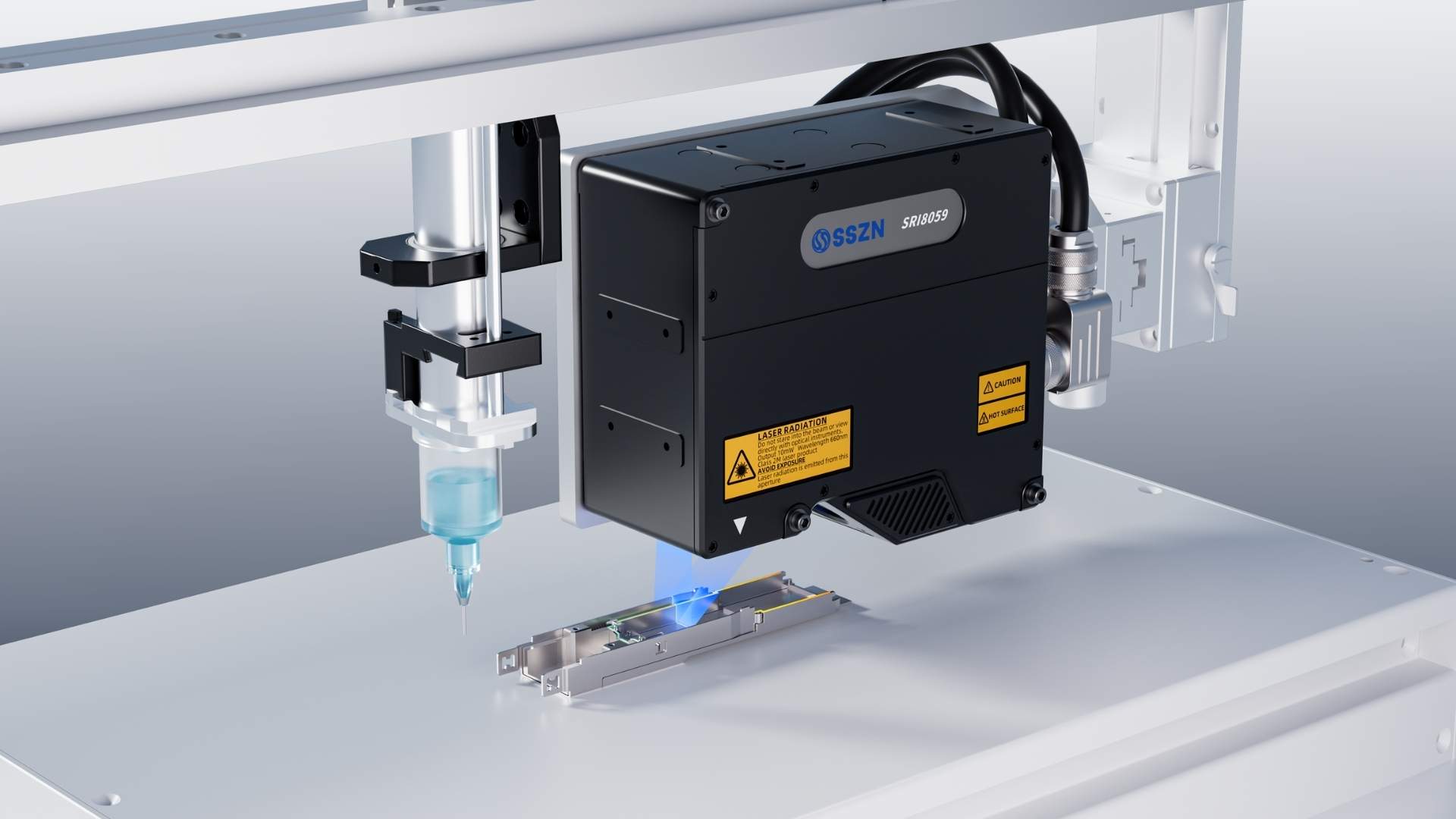
Dispensing Guidance for Optical Module Housings in AI Servers
In AI hardware manufacturing, applying adhesive to AI servers requires precise nozzle height control. The SinceVision 3d laser profiler provides dynamic dispensing guidance for optical module housings. By capturing precise spatial data across the X, Y, and Z axes, the laser profiler controls stepped surface height differences to within 0.01 mm. This high precision optical triangulation overcomes the high reflectivity of metal housings, guaranteeing uniform adhesive application and eliminating assembly defects.
 Product Inquiry
Related tags
Executive Summary
Challenges: Applying adhesive to optical module housings in AI servers requires strict spatial control. Dispensing nozzles are highly sensitive to surface height variations, and stepped surfaces demand vertical precision controlled to within 0.01 mm.
Solution: Integrating a SinceVision 3D laser profiler enables continuous 3D scanning to generate dynamic, high precision dispensing paths across the X, Y, and Z axes.
Key Specifications: The system captures high resolution 3D height data and handles high reflectivity metal housings with narrow frames, controlling height deviations strictly within 0.01 mm.
Engineering Impact: Implementing advanced 3D sensors provides highly reliable dispensing guidance in AI hardware manufacturing, ensuring robust thermal and structural integrity without reflective interference.
The Engineering Challenge: Dispensing on Optical Module Housings
Optical modules serve as the critical data transmission backbone within AI servers. During the manufacturing of these components, applying adhesive to the metal housings is a highly delicate operation. The dispensing process is extremely sensitive to the spacing and height of the dispensing nozzle relative to the housing surface.
Because optical module housings have inherent manufacturing tolerances in both flatness and thickness, a static dispensing path is inadequate. Furthermore, the housing structures often feature stepped surfaces where the height difference must be controlled strictly within 0.01 mm. A successful dispensing path not only requires precise positioning along the X and Y axes but also mandates rigorous height control along the Z axis. If the nozzle height fluctuates, the adhesive volume becomes inconsistent, leading to thermal failure or structural weakness in the final assembly.
The Solution: 3D Laser Profilers for Dispensing Guidance
To eliminate dispensing errors in AI hardware manufacturing, facilities utilize SinceVision 3D laser profilers to guide the dispensing equipment dynamically. Before the adhesive drops, the 3D laser profiler performs a complete 3D scan of the optical module housing.
Combined with advanced inspection software, the sensor acquires absolute product height data and generates a customized, high precision dispensing path for every individual unit. This method ensures that the dispensing nozzle maintains a perfect standoff distance, dynamically compensating for any flatness or thickness variations on the metal housing.
Core Technical Advantages
Precise 3D Positioning: The laser profiler simultaneously captures structural contour information in the XY coordinates and exact height information along the Z axis. This comprehensive spatial data guarantees that the dispensing path perfectly matches the unique physical structure of each product.
Immunity to Reflective Interference: Metal optical module housings are highly reflective. By relying on absolute 3D height data detection rather than 2D grayscale contrast, the sensor remains completely unaffected by surface reflectivity. Furthermore, because the sensor handles chamfered corners and narrow frames without causing optical obstructions, it secures the precise positioning of the dispensing path reference.
Technology Comparison: Dispensing Guidance Methods
| Guidance Method | Measurement Principle | Dimensional Control | Reflectivity Handling | Engineering Impact |
| Static Fixed Path | No active measurement | Low (Ignores surface variations) | N/A | High defect rate on stepped surfaces |
| 2D Vision Cameras | Pixel contrast mapping | XY positioning only (No Z axis control) | Poor (Fails on shiny metal housings) | Cannot compensate for housing thickness tolerances |
| SinceVision 3D Laser Profiler | Optical 3D triangulation | High (Controls Z axis to within 0.01 mm) | Excellent (Unaffected by grayscale contrast) | Maximizes yield in AI hardware manufacturing |
Frequently Asked Questions (FAQs)
Why is Z-axis control critical when dispensing adhesive on optical modules?
Optical modules in AI servers have extremely tight internal tolerances. If the dispensing nozzle is too high, the adhesive bead will be too thin. If it is too low, the nozzle may crash into stepped surfaces or dispense excess adhesive. Precise Z-axis control ensures a uniform adhesive layer for optimal thermal dissipation and structural sealing.
How does a 3D laser profiler handle shiny metal housings?
Traditional 2D cameras rely on surface contrast and struggle with glare from polished metals. A 3D laser profiler uses optical triangulation to measure the physical geometry of the target. Because it detects the actual height of the laser line rather than the color or shade of the surface, it provides stable measurement data regardless of high reflectivity.
What is the benefit of dynamic path generation?
Dynamic path generation allows the dispensing robot to adjust its movement in real time based on the exact dimensional scan of the specific housing in front of it. This compensates for acceptable manufacturing tolerances in the housing material, ensuring perfect adhesive application without requiring perfectly identical raw materials.






 Compare
 Clear the comparison bar
