









Glue Dispensing Guidance for AI Server Optical Modules
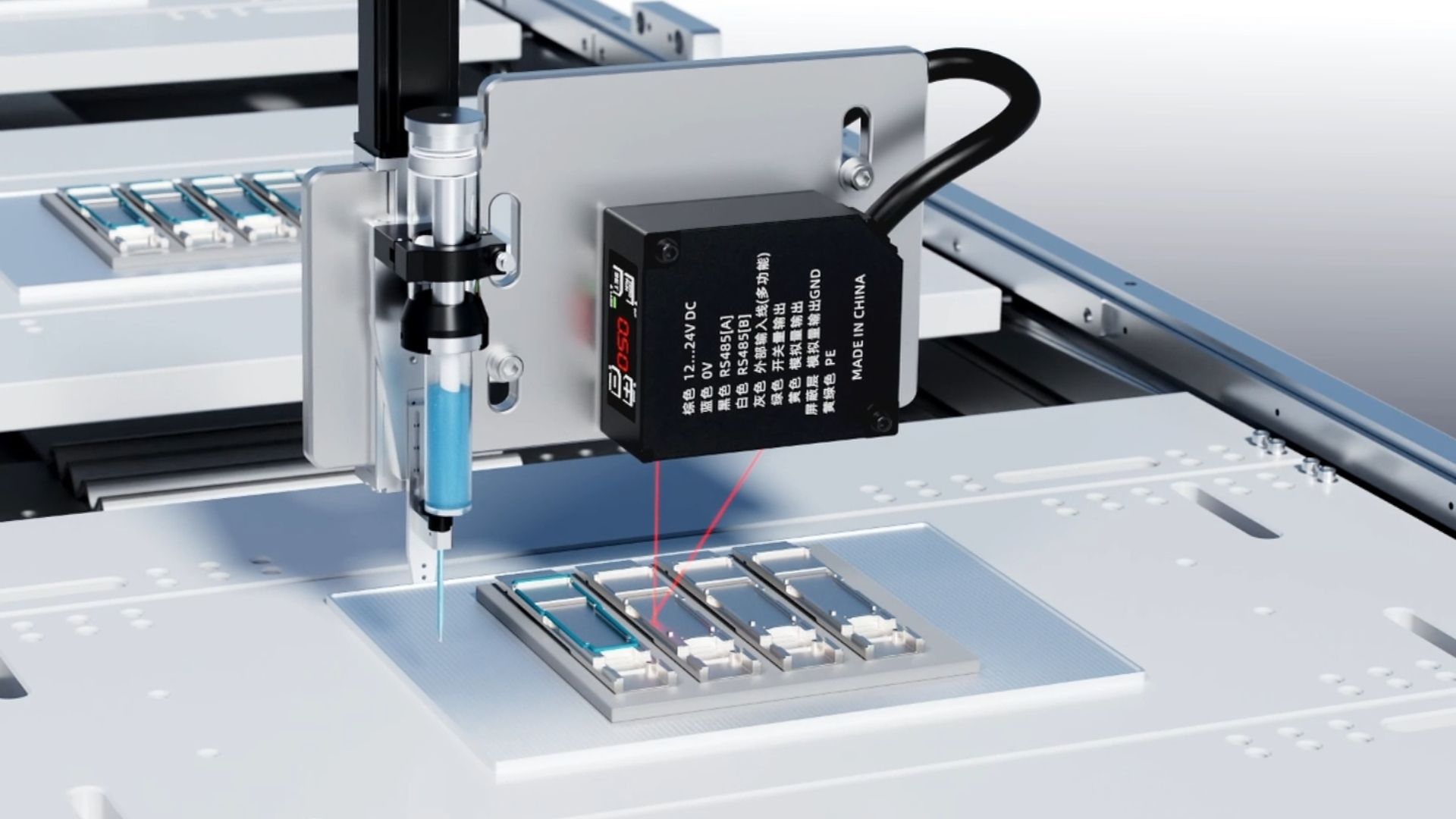
SinceVision SD33-50 laser displacement sensor provides real-time height tracking for automated optical module glue dispensing in AI server manufacturing. Operating at 3 kHz with 5 μm repeatability, this non-contact dispensing sensor dynamically compensates for metal housing surface variations to ensure uniform adhesive beads and reliable hermetic sealing.
 Product Inquiry
In AI server manufacturing and high-speed optical transceiver assembly, dispensing distance variations cause uneven adhesive layers, nozzle collisions, and hermetic seal failures. The SinceVision SD33-50 laser displacement sensor provides real-time height tracking for automated fluid dispensing valves. With a 3 kHz sampling frequency and 5 μm repeatability, this non-contact dispensing sensor measures reflective metal housing contours inline, enabling closed-loop Z-axis trajectory compensation during optical module glue dispensing.
| Process Metric | Technical Specification | Operational Value in AI Hardware Manufacturing |
Sensor | SD33-50 Laser Displacement Sensor | Non-contact dispensing sensor mounted co-axially with dispensing head |
Repeatability | 5 μm | Micron-level precision for consistent dispensing distance control |
Sampling Frequency | Up to 3 kHz | Real-time height tracking during high-speed motion trajectories |
Target Workpieces | Optical transceivers (400G, 800G, 1.6T) and power modules | Highly reflective die-cast aluminum and nickel-plated housings |
Primary Process Defect Prevented | Adhesive overflow, broken bond lines, and seal leaks | Eliminates bead height variations caused by housing surface waviness |
1. Dispensing Distance: Critical Process Control in Optical Module Assembly
As AI computing clusters expand, optical modules are evolving toward higher data rates (800G and 1.6T) and ultra-compact form factors. In AI hardware manufacturing, adhesive dispensing is a critical assembly step for securing covers to transceiver housings, providing environmental sealing, and ensuring structural stability under high thermal loads.
Fixed-height dispensing creates significant quality risks:
Substrate Waviness: Stamped or die-cast metal housings exhibit surface height deviations across production lots. Dispensing at a fixed Z-coordinate causes the gap between the nozzle tip and the housing to fluctuate continuously.
Adhesive Bead Non-Uniformity: When the dispensing distance narrows, the adhesive bead spreads too wide, overflowing into optical keep-out zones and lens cavities. When the distance widens, the bead thins or breaks, leading to seal failure, moisture ingress, and thermal degradation.
Surface Reflection Interference: Polished, nickel-plated, and machined metal surfaces generate intense specular reflections that compromise conventional optical sensors.
Maintaining an exact dispensing distance across reflective metal housings requires real-time height tracking before or during the dispensing pass.
2. Real-Time Height Tracking for Closed-Loop Dispensing Guidance
The SinceVision SD33-50 laser displacement sensor is installed directly beside the dispensing valve to provide continuous laser displacement sensor dispensing guidance.
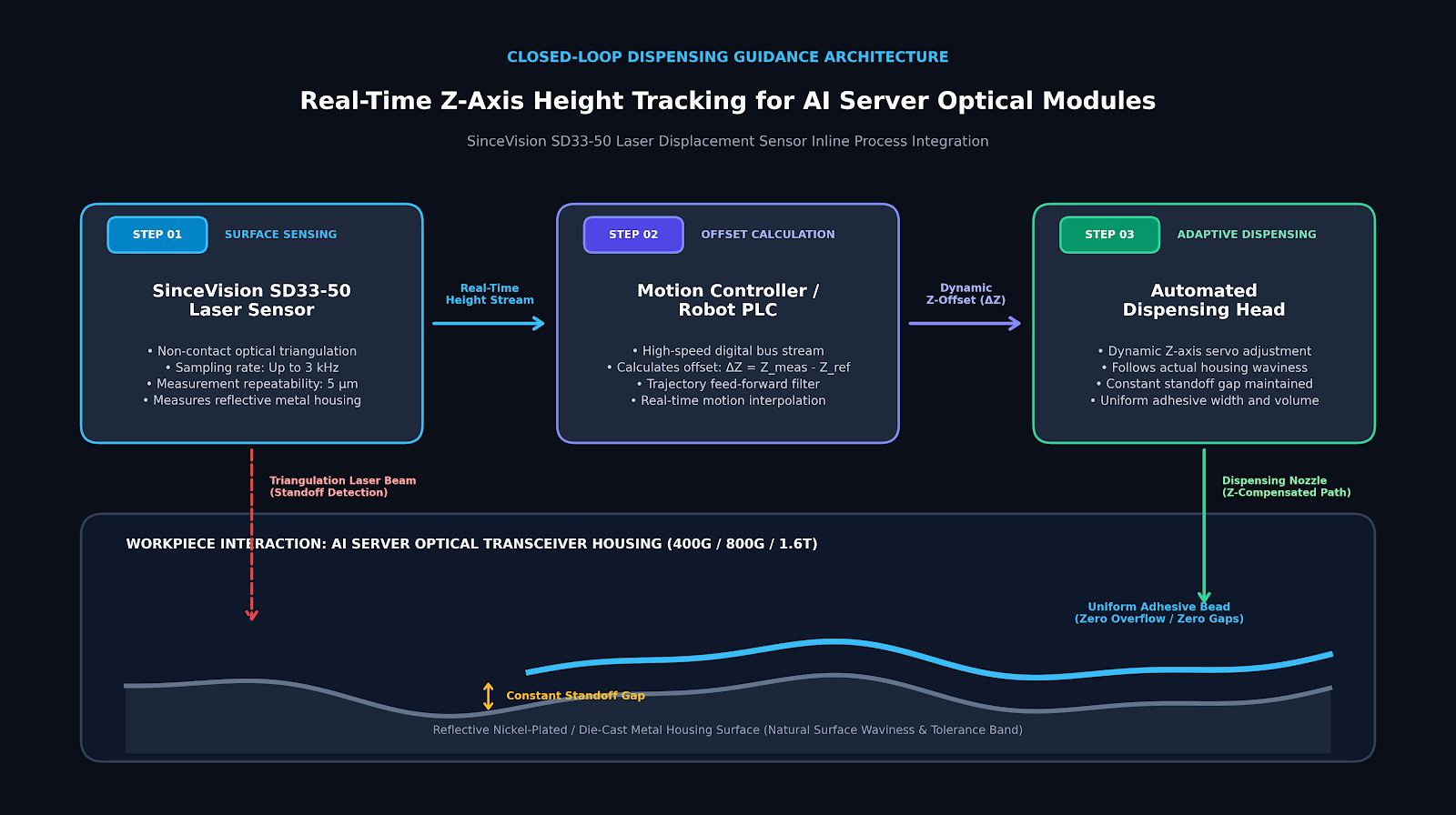
Image: Real-Time Height Tracking for Closed-Loop Dispensing Guidance
Process Workflow
High-Speed Surface Measurement: The sensor projects a focused laser spot onto the housing surface, collecting precise elevation data at sampling frequencies up to 3 kHz.
Dynamic Trajectory Compensation: The system streams height data to the motion controller, which computes deviations from nominal values in milliseconds.
Adaptive Nozzle Positioning: The dispensing valve dynamically adjusts its Z-axis position to follow actual housing contours, keeping the dispensing distance constant across the entire toolpath.
3. Key Advantages for Optical Module Glue Dispensing
Non-Contact Dispensing Sensor: Optical triangulation eliminates mechanical probe contact, preventing surface scratches and physical deformation on precision optical transceivers.
5 μm Repeatability: Micron-level measurement stability ensures consistent adhesive bead volume and width across high-volume production shifts.
Dynamic Z-Axis Height Tracking: High-speed real-time feedback allows the dispensing tip to adjust instantly to local surface warpage.
Inline Production Efficiency: The 3 kHz response rate allows rapid pre-dispensing height acquisition without increasing station cycle times.
Specular Reflection Stability: Advanced optical filtering handles reflective nickel, copper, and aluminum surfaces without requiring anti-glare coatings.
4. Expanding Applications Across AI Hardware Manufacturing
Beyond optical module glue dispensing, the SinceVision SD33-50 supports multiple critical stages in AI server manufacturing:
AI Server Chassis and Structure Assembly: Height verification, component seating checks, and thermal interface material (TIM) dispensing guidance.
Power Module Sealing: Precision cover bonding and potting height control for server power supplies and voltage regulator modules (VRMs).
3C Electronics Fabrication: Standoff distance control and gap inspection for smartphone mid-frames, wearable device housings, and camera modules.
Semiconductor and Mezzanine Packaging: Substrate coplanarity checks and adhesive underfill guidance for high-density compute boards.
Download the SD33-50 product datasheet here






 Compare
 Clear the comparison bar

