










LGA Packaged Chip PIN Height Measurement: Achieving Yield Stability with 0.1μm Precision
Discover how 3D laser profiling enables accurate LGA packaged chip PIN height measurement with 0.1μm repeatability for higher yield.


Why PIN Height Control Directly Impacts Profitability
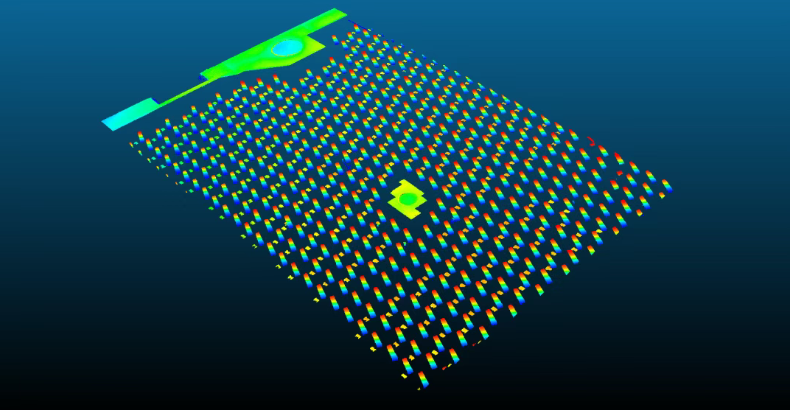
In LGA packaged chip manufacturing, uncontrolled PIN height variation is a direct contributor to yield loss and latent electrical failure. Even deviations at the micron level can compromise coplanarity, leading to unstable solder joints, intermittent contact, or complete assembly failure. These issues often remain undetected until late in the production cycle, where the cost of scrap, rework, or customer returns escalates sharply.
As packaging density increases and tolerances continue to tighten, LGA packaged chip PIN height measurement is no longer a quality check—it is a critical process control step. Manufacturers now require inspection solutions that deliver sub-micron precision at production speed, without introducing new risks to fragile chip structures.
Core Challenge: Speed Versus Precision in PIN Height Inspection
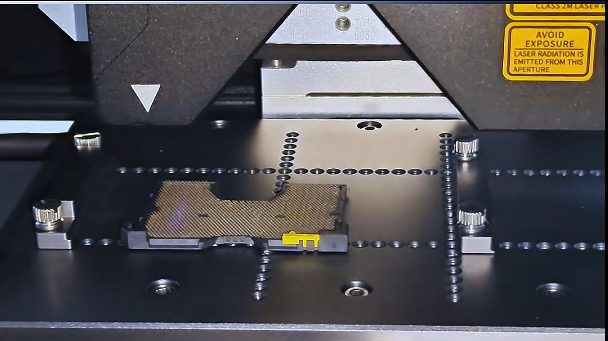
Traditional inspection methods struggle to meet the competing demands of accuracy, speed, and scalability. Contact-based measurement tools can achieve acceptable precision in controlled environments, but they are fundamentally unsuited to high-volume semiconductor production. Physical probing risks damaging PINs, slows inspection cycles, and introduces measurement drift as probes wear.
Standard optical inspection systems, commonly used in automated optical inspection (AOI) for chips, address throughput concerns but fall short in height accuracy. Most 2D optical methods infer height indirectly, making them sensitive to surface reflectivity and lighting conditions. As a result, subtle PIN height variations are often missed, only to surface later as solder defects.
This speed-versus-precision trade-off has driven the adoption of true 3D measurement technologies.
SinceVision SR9040: A Purpose-Built Solution for LGA PIN Height Measurement
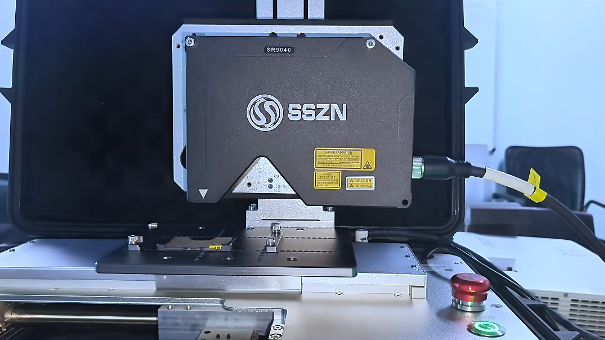
The SinceVision SR9040 3D Laser Profile Measuring Instrument is designed specifically to resolve the limitations of both contact and conventional optical inspection. By combining non-contact laser profiling with high-speed data acquisition, it delivers stable, repeatable height measurement suitable for inline semiconductor manufacturing.
At the core of the SR9040’s performance is its ability to generate dense, high-resolution 3D profiles of both the chip surface and individual PIN structures. This enables true height measurement rather than estimation, ensuring consistent results across large production volumes.
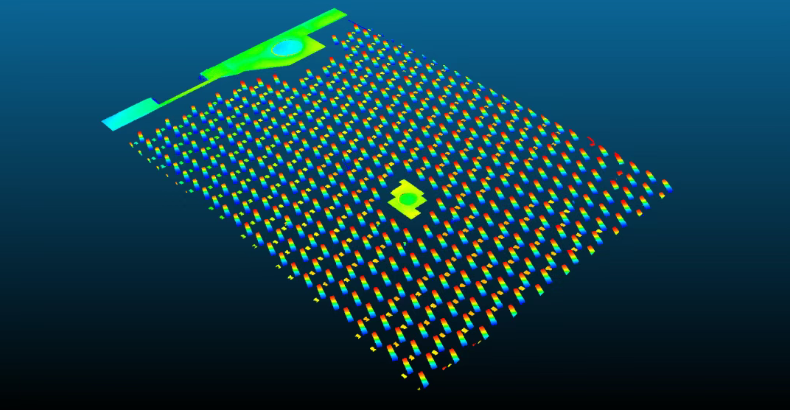
Image: 3D point cloud of LGA chip pins
Key Technical Specifications
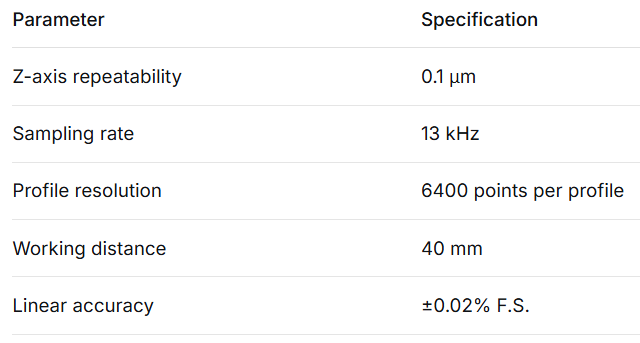
This combination allows the SR9040 to maintain micron-level accuracy even during dynamic, high-speed inspection.
How 3D Laser Profiling Improves PIN Height Control
Unlike traditional AOI systems, 3D laser profiling directly measures height along the Z-axis. The SR9040 captures a complete cross-sectional profile of the LGA package, ensuring that each PIN is evaluated relative to a stable reference plane. High Z-axis repeatability ensures that measurements remain consistent over time, independent of production speed or environmental variation.
This approach removes the inspection tool itself as a source of variability, allowing manufacturers to focus on controlling the upstream process rather than compensating for measurement uncertainty.
Application Breakdown in LGA Chip Production
Pre-Soldering Coplanarity Inspection
Before soldering, PIN coplanarity determines whether electrical connections will form correctly. Even minor height deviations can result in open circuits or uneven solder distribution. Using the SR9040, manufacturers can measure PIN height variation across the entire package prior to soldering, identifying out-of-tolerance conditions early and preventing defects from propagating downstream.
This pre-soldering control is particularly valuable in high-density LGA designs, where rework is costly or impossible.
Post-Soldering Quality Diagnosis
After soldering, height and profile data provide insight into solder joint integrity that 2D inspection cannot deliver. The SR9040 supports detailed solder quality inspection, revealing issues such as bridging, cold joints, or PIN collapse through changes in height and profile geometry. This enables faster root-cause analysis and more effective process tuning.
Software, SDK, and Smart Factory Integration
In modern semiconductor fabs, inspection systems must integrate seamlessly into automated production lines. The SR9040 is supported by dedicated inspection software and a flexible SDK, enabling manufacturers to embed PIN height measurement into existing workflows.
The system supports 100% online inspection, allowing continuous data collection without interrupting throughput. When connected to factory control systems, this data becomes a powerful input for closed-loop process optimization, aligning with smart factory and Industry 4.0 initiatives.
Conclusion
As LGA packaging technology advances, inspection methods must evolve accordingly. LGA packaged chip PIN height measurement demands a solution that delivers both sub-micron precision and production-line efficiency. The SinceVision SR9040 meets this requirement through high-density 3D laser profiling, 0.1μm Z-axis repeatability, and robust integration capabilities.
By enabling accurate pre-soldering coplanarity control and post-soldering quality diagnosis, the SR9040 helps manufacturers reduce defects, stabilize yield, and improve long-term process reliability.
Frequently Asked Questions
What is the best way to measure LGA PIN height in production?
Non-contact 3D laser profile measurement provides the most reliable balance of precision, speed, and repeatability.
How does 3D laser profiling improve semiconductor yield?
It detects micron-level height variations early, preventing solder defects and reducing downstream failures.
Why is Z-axis repeatability important for PIN height inspection?
High repeatability ensures consistent measurements across large volumes, supporting stable and predictable process control.

You can also read
Unlocking Flame Cellular Instability: Advanced High-Speed Camera Flame Imaging with the SinceVision SH8 Series
Oct 09, 2026
Analyzing Brittle Fracture in Tomato Roots: A SinceVision High-Speed Camera & DIC Experiment for Agricultural Robotics
Sep 01, 2026
3D Laser Profiler for Lithium-Ion Battery Top Cover Bonding Height Measurement
Aug 14, 2026
Observation of Embryonic Fibroblasts with sCMOS Camera for Multichannel Imaging
Jun 23, 2026
Automating Automotive Body Gap Detection with the SinceVision SR8060H 3D Laser Profiler
Jun 05, 2026



 Compare
 Clear the comparison bar
