










How to Measure Tiny Hole Depth with Micron Precision: SCI Confocal Sensors Solution
Learn how confocal displacement sensors enable accurate, non-contact tiny hole depth measurement for high-yield manufacturing.
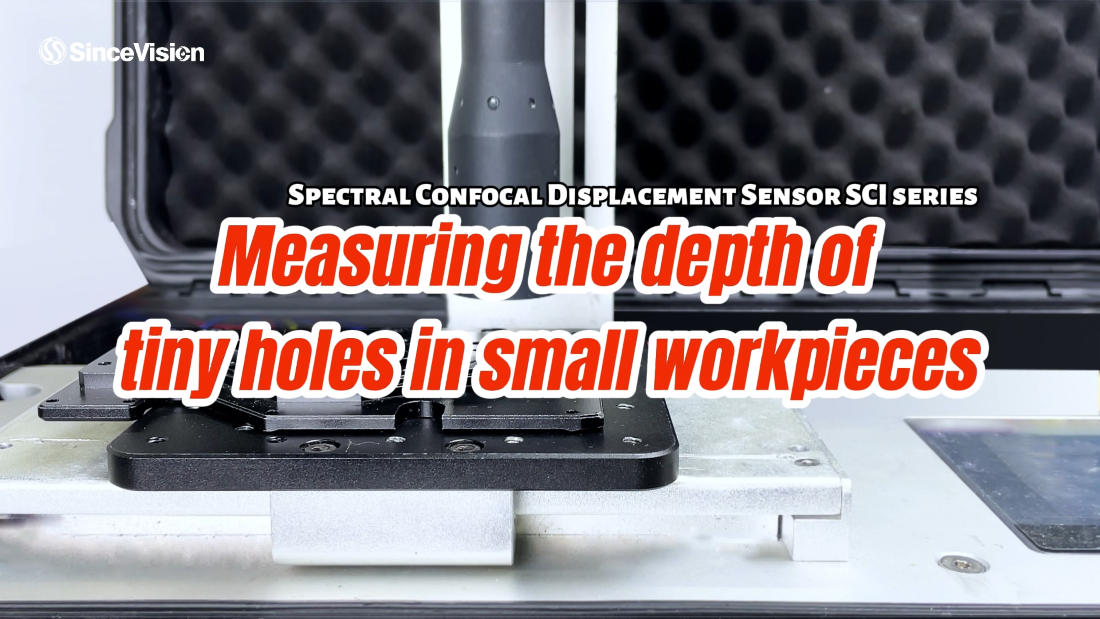


Measuring tiny hole depth is a persistent challenge in modern manufacturing, especially as components become smaller and tolerances tighter. In industries such as electronics, precision mechanics, and advanced manufacturing, depth deviations of just a few microns can lead to assembly issues, electrical failures, or reduced product yield. Traditional contact-based tools often struggle under these conditions. As a result, non-contact depth measurement using a confocal displacement sensor has become a preferred approach for manufacturers seeking stable, repeatable, and micron-level accuracy.
This article explains why tiny hole depth measurement is difficult, how confocal technology works, and how the SCI04025 confocal displacement sensor provides a practical and scalable solution for industrial applications.
Why Measuring Tiny Hole Depth Is Difficult in Manufacturing
Tiny holes, particularly blind holes, present measurement difficulties that go far beyond simple dimensional inspection. In electronics manufacturing, for example, holes are often narrow, deep, and located on reflective or delicate surfaces. Access to the hole bottom is limited, and even minor probe misalignment can produce inaccurate readings.
Mechanical depth gauges compound these challenges. Because they rely on physical contact, measurement accuracy degrades over time as probes wear. Contact force can also damage small workpieces or deform soft materials, introducing variability into the process. These limitations make traditional tools unsuitable for micron-level hole inspection in high-volume or automated environments.
Mechanical Depth Gauges vs. Confocal Sensors
Why Contact Measurement Falls Short
Mechanical depth gauges are still used in some workshops, but they are increasingly incompatible with modern production demands. Repeated contact leads to wear, while vibration, operator technique, and tool calibration introduce inconsistencies. In automated lines, these issues scale quickly and directly affect yield.
How Confocal Displacement Sensors Work
A confocal displacement sensor measures distance optically rather than mechanically. By detecting reflected light at specific focal points, the sensor can identify both the surface of a part and the bottom of a hole without touching either. This principle enables non-contact depth measurement with high repeatability and micron-level resolution.
For manufacturers, the most important advantage is stability. Because there is no physical probe, measurement accuracy does not degrade over time, making confocal sensors suitable for continuous industrial use.
The SCI Series Confocal Displacement Sensor Explained
Designed for Tiny Hole Depth Measurement
The SCI04025 confocal displacement sensor from SinceVision is specifically developed for precise measurement of tiny holes in small workpieces. It addresses the core weaknesses of mechanical methods by combining optical accuracy with industrial robustness.
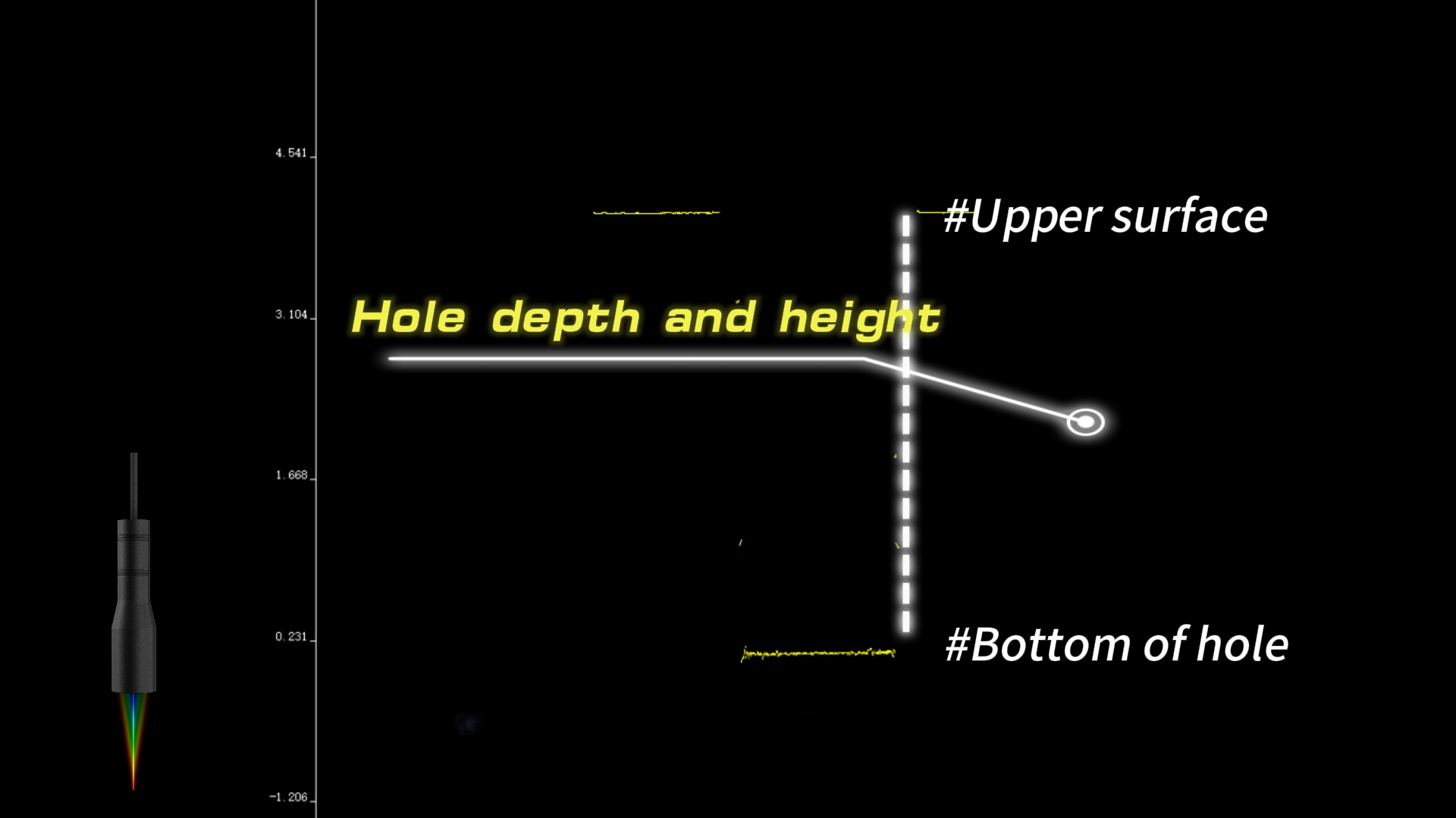
The sensor determines hole depth by measuring two critical points: the top surface reference and the bottom of the hole. The depth value is calculated from the height difference, ensuring reliable results even when hole geometry is challenging.
Key Measurement Capabilities
The SCI04025 provides several capabilities that are particularly relevant for manufacturing environments:
1. Precise height calculation by referencing both surface and hole bottom
2. Accurate depth profile generation for detecting drilling quality issues
3. Stable performance during large-scale drilling inspection without sensor wear
These capabilities make the SCI Series suitable for automated blind hole measurement where consistency and throughput are critical.
Why Non-Contact Measurement Improves Manufacturing Yield
High-yield manufacturing depends on consistent inspection results. Measurement drift, tool wear, and part damage all contribute to scrap and rework. By eliminating physical contact, the SCI Series reduces these risks at the measurement stage.
In production lines handling large volumes of drilled parts, non-wear industrial sensors offer a clear advantage. Measurement accuracy remains constant over time, supporting tighter process control and reducing the need for frequent recalibration. For quality teams, this translates directly into lower inspection-related downtime and more predictable output.
Applications Requiring Micron-Level Hole Inspection
Electronics and Precision Components
In electronics manufacturing, tiny hole depth affects electrical conductivity, connector reliability, and assembly precision. Confocal sensors allow manufacturers to verify depth inline without slowing production or risking component damage.
Precision R&D Measurement
In research and development environments, flexibility and accuracy are equally important. Engineers need reliable data to validate drilling processes, materials, and designs. The SCI Series supports precision R&D measurement by delivering high-resolution depth data without requiring custom tooling.
Best Practices for Automated Tiny Hole Measurement
To fully benefit from confocal displacement sensors, manufacturers should establish a stable surface reference and ensure consistent sensor alignment. Integrating the sensor with motion systems enables repeatable measurements across batches, while depth profile data can be used to monitor drilling trends and detect early process deviations.
These practices help manufacturers move beyond inspection toward continuous process optimization.
Conclusion
Measuring tiny hole depth with micron precision is no longer achievable with traditional mechanical tools alone. As tolerances tighten and production volumes increase, confocal displacement sensors provide a reliable, non-contact depth measurement solution. The SCI04025 confocal displacement sensor combines precise height calculation, accurate profile generation, and wear-free operation to meet the demands of modern manufacturing.
For manufacturers seeking higher yield, stable quality, and scalable inspection, the SCI Series offers a proven path forward. Exploring its capabilities or reviewing real-world demonstrations is a logical next step toward improving tiny hole measurement performance.
Frequently Asked Questions
What is the most accurate way to measure tiny hole depth?
Non-contact confocal displacement sensors offer micron-level accuracy without probe wear.
Can confocal sensors measure blind holes reliably?
Yes. They measure both the surface and hole bottom to calculate precise depth.
Why is non-contact depth measurement better for automation?
It eliminates wear and reduces variability, making results stable over long production runs.
Is the SCI Series suitable for high-volume manufacturing?
Yes. It is designed to handle large quantities of drilling without accuracy degradation.
Which industries benefit most from micron-level hole inspection?
Electronics, precision mechanics, medical devices, and advanced manufacturing R&D.

You can also read
Analyzing Brittle Fracture in Tomato Roots: A SinceVision High-Speed Camera & DIC Experiment for Agricultural Robotics
Sep 01, 2026
Discover Advanced High-Speed Camera Solutions for Structural Mechanics at the 2026 BSSM Conference in Swansea, UK
Aug 19, 2026
3D Laser Profiler for Lithium-Ion Battery Top Cover Bonding Height Measurement
Aug 14, 2026
Observation of Embryonic Fibroblasts with sCMOS Camera for Multichannel Imaging
Jun 23, 2026
Automating Automotive Body Gap Detection with the SinceVision SR8060H 3D Laser Profiler
Jun 05, 2026



 Compare
 Clear the comparison bar
