










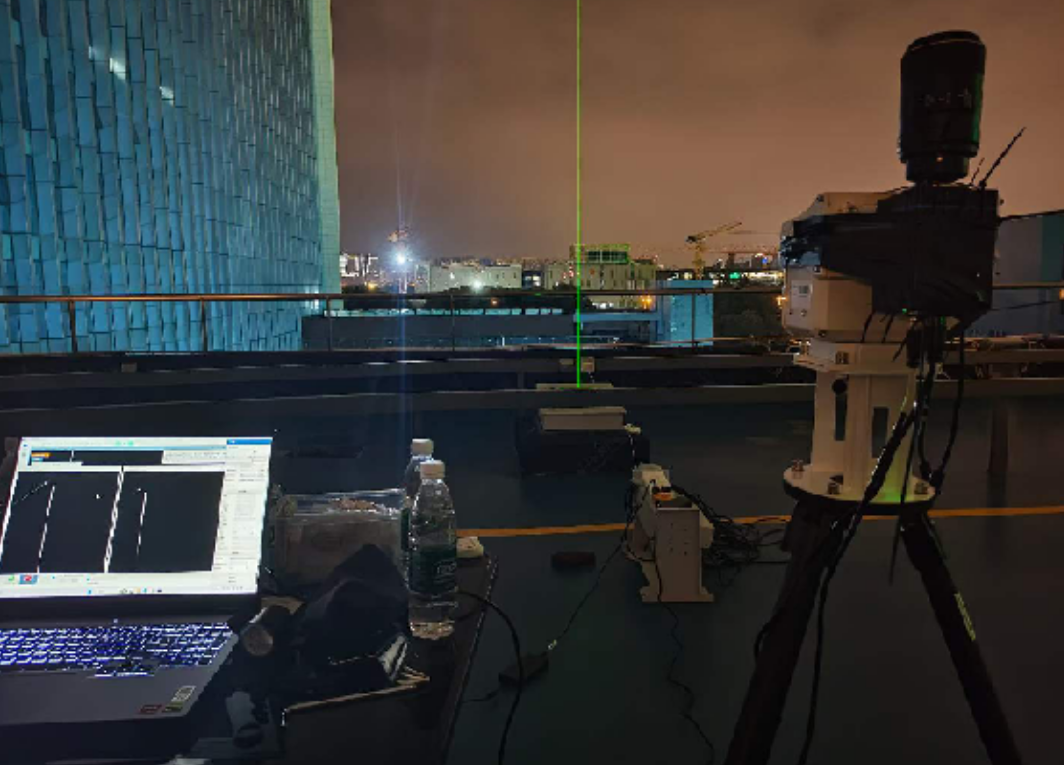
Atmospheric Laser Transmission and Scattering Observations
SinceVision Solis B0465 overcomes the limitations of traditional LiDAR and standard CMOS sensors by offering 95% peak quantum efficiency (QE) and ultra-low noise (1.1 e⁻ readout, 0.08 e⁻/pixel/s dark current at -30°C) for detecting weak, long-range aerosol and cloud backscatter. Solis B0465 an essential camera for meteorological research and dual-wavelength optical monitoring.
 Product Inquiry
Related tags
Overview: Optical Challenges in Atmospheric Scattering
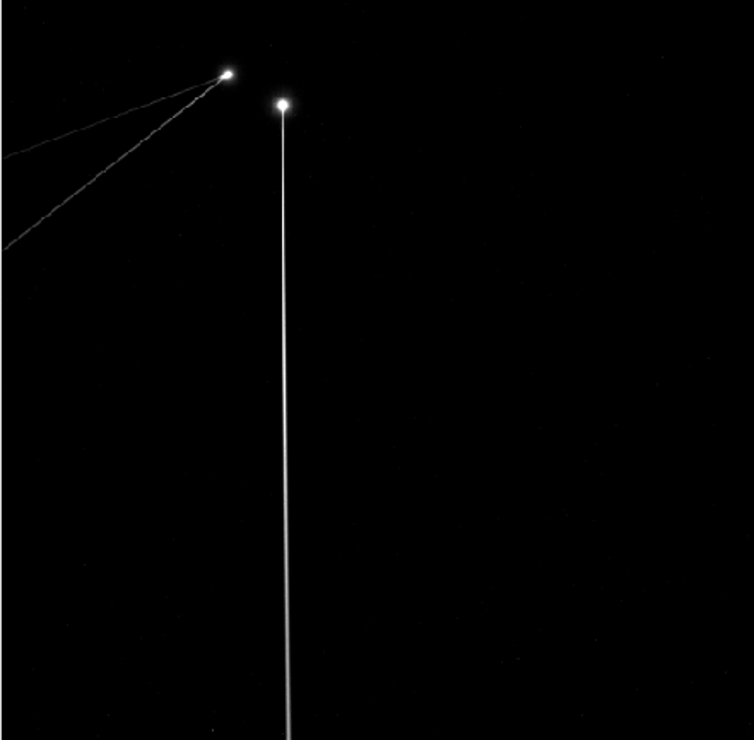
In meteorological research and atmospheric optics, lateral laser scattering imaging at 355 nm (UV) and 532 nm (visible) is critical for tracking laser beam propagation, divergence, beam jitter, and identifying aerosol layers, cloud boundaries, and localized air pollution.
Capturing these phenomena over long distances presents severe optical challenges:
Severe Photon Attenuation: Scattered photon flux decays rapidly over long transmission paths.
High Sky Background Noise: Daylight and ambient sky noise degrade the signal-to-noise ratio (SNR). Narrowband filters help suppress stray light but also reduce total photon throughput.
Dual-Wavelength Response Disparity: UV (355 nm) and visible (532 nm) wavelengths exhibit stark differences in atmospheric transmission and sensor quantum efficiency.
Field-of-View vs. Spatial Resolution Trade-Off: Capturing long-range beam paths requires a wide field of view (FOV) while retaining fine pixel resolution to detect localized atmospheric structures.
Limitations of LiDAR Alone: While LiDAR provides 1D range-resolved backscatter echoes, it cannot deliver continuous 2D spatial beam morphology or dynamic lateral profiles.
Experimental System Configuration
[ Pulsed Nd:YAG Laser (355nm / 532nm) ]
                   │
                   ▼ (Atmospheric Transmission & Scattering)
[ Receiving Optics (Fused Silica UV / Visible Lens) ]
                   │
[ Narrowband Filters (355 ± 5nm / 532 ± 5nm or 1-3nm Ultra-Narrow) ]
                   │
[ Solis B0465 sCMOS Camera (Deep-Cooled @ -30°C, 10 GigE Triggered) ]
                   │
                   ▼
[ 2D Spatial Morphology & Quantitative Scatter Analysis ]
Laser Source: Dual-wavelength Q-switched Nd:YAG laser (532 nm frequency-doubled / 355 nm frequency-tripled).
Optical System: Fused silica UV-reflective coated lens (355 nm) and visible-grade optical lens (532 nm).
Filtration: 355 ± 5 nm and 532 ± 5 nm standard filters (or 1–3 nm ultra-narrowband filters for intense daylight suppression).
Calibration Protocol: Sequential acquisition of dark-field, lens-cap background, and uniform-field flat frames with pulse-energy normalization for real-time background subtraction.
Solution: High-Sensitivity, Deep-Cooled sCMOS Imaging
To overcome these bottlenecks, SinceVision deploys the Solis B0465 Back-Illuminated sCMOS Camera, combining deep thermoelectric cooling, high quantum efficiency, and low readout noise to deliver high-contrast 2D beam profiles that complement standard LiDAR systems.
1. Dual-Wavelength Sensitivity with 95% Peak QE
The back-illuminated sensor architecture provides up to 95% peak quantum efficiency (QE) at 560 nm, delivering exceptional photon collection efficiency for 532 nm Nd:YAG second-harmonic scattering. When paired with UV-grade fused silica optics and calibrated narrowband filters, the system maintains high detection capability at 355 nm third-harmonic wavelengths.
2. Deep Cooling (-30°C) & Ultra-Low Noise
Long exposure times and multi-pulse integration often introduce thermal noise. The Solis B0465 features:
Readout Noise: Down to 1.1 e⁻ (median), preserving weak scattering signals.
Dark Current: Suppressed to 0.08 e⁻/pixel/s at -30°C, preventing dark noise accumulation during extended exposures up to 60 seconds.
3. Wide FOV with High Spatial Resolution
Featuring a 2048 × 2046 resolution with 6.5 µm pixels across an 18.8 mm diagonal target surface, the camera captures wide atmospheric corridors while resolving micro-scale beam divergence, offset, and thin cloud stratifications.
4. High-Speed Synchronization & Dynamic Tracking
Equipped with both 10 GigE (up to 100 fps full frame) and USB 3.0 (up to 30 fps) interfaces, the camera supports sub-microsecond hardware trigger synchronization with pulsed Nd:YAG Q-switched lasers to track high-speed atmospheric turbulence and transient beam jitter in real time.
Featured Hardware: Solis B0465 sCMOS Camera
| Parameter | Specification |
| Sensor Type | Back-Illuminated Scientific CMOS (sCMOS) |
| Active Resolution | 2048 (H) × 2046 (V) (~4.2 MP) |
| Pixel Size | 6.5 µm × 6.5 µm |
| Optical Format | 18.8 mm diagonal |
| Peak Quantum Efficiency | 95% @ 560 nm |
| Readout Noise | 1.1 e⁻ (Median) |
| Cooling & Dark Current | -30 °C (Thermoelectric) / 0.08 e⁻/pixel/s |
| Frame Rate | 100 fps (10 GigE) / 30 fps (USB 3.0) |
| Exposure Range | 7.2 µs to 60 s |
| Triggering Modes | External hardware trigger, software trigger |
Summary & Key Takeaways
Integrating the SinceVision Solis B0465 sCMOS camera into atmospheric laser observation systems bridges the gap between 1D LiDAR point data and 2D spatial visualization. By combining deep-cooled thermal suppression with high quantum efficiency and ultra-fast 10 GigE data output, scientific researchers gain an optimized platform for long-range aerosol mapping, laser propagation analysis, and environmental monitoring.






 Compare
 Clear the comparison bar
