

Observation of Nematodes Under Fluorescence

Observation of Nematodes Under Fluorescence

Discover how SinceVision's Solis B0465 high-speed sCMOS camera eliminates motion blur and enhances weak fluorescence detection in nematode research. Designed for neuroscience and C. elegans behavior tracking.

Product Inquiry

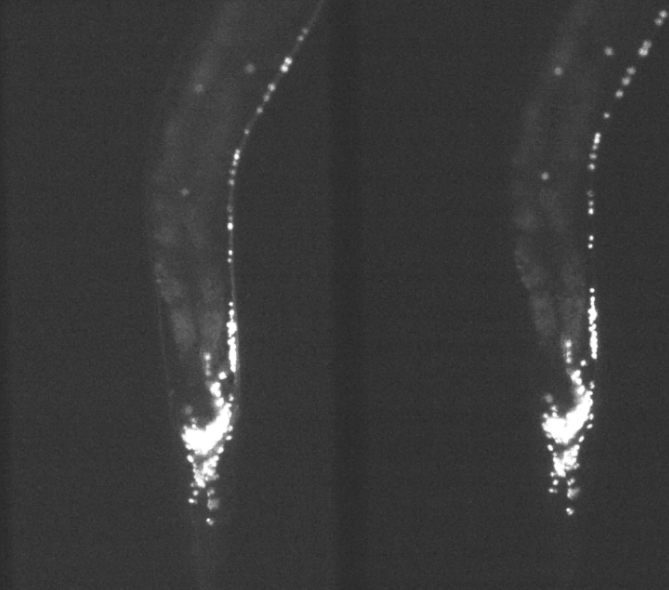
In neuroscience and genetics research, scientists often need to simultaneously capture multi-angle fluorescent signals and locomotion behavior of model organisms (such as nematodes). However, traditional imaging methods are limited by the tradeoff between exposure time, signal intensity, and optical noise, making it difficult to balance image clarity and signal fidelity:


Contradiction between motion blur and weak fluorescence:
Nematodes have high movement speeds (50–200 μm/s). If exposure is extended to enhance fluorescence brightness, motion streaks greater than 10 μm can occur, which severely affects trajectory analysis.


Signal attenuation and crosstalk in spectral imaging:
Multi-angle light splitting drastically reduces effective light intensity. In addition, excitation light scattering further lowers the signal-to-noise ratio, interfering with both quantitative neuron fluorescence analysis and behavior association studies.


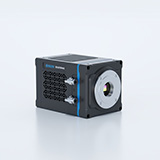
SinceVision Solution: Solis-B0465 sCMOS Camera

01High-resolution, high-speed synchronized imaging balancing fluorescence and movement tracking: Frame rate of 100 fps and short 10 ms exposures clearly capture nematodes’ rapid movements (less than 2 μm motion blur per frame), supporting both GFP fluorescence imaging and behavioral analysis needs.

02High quantum efficiency enhances signal-to-noise ratio and addresses spectral attenuation: With a quantum efficiency (QE) of ≥90% at 520 nm, significant compensation is provided for intensity loss in the optical system (about 65%), ensuring even weak fluorescence signals are captured clearly and minimizing the impact of excitation light crosstalk.

03High dynamic range accommodates signal differences: A 90 dB high dynamic range allows simultaneous imaging of strongly expressed regions (such as the head) and weak signals (like tail neurons), avoiding over- or under-exposure to guarantee comprehensive and reliable quantitative data.


34335.png


How can we help you?

How can we help you?

Tell us your challenge. We will solve it.

Apply for
a trial
SinceVision

How can we help you?

Thank you for considering SinceVision.

Please fill out the form below and let us know how we can assist you.

We value your feedback and inquiries. Our team will get back to you shortly.

  • Your question:

  • *Your full name

  • *Company name

  • *Industry

  • *Country

  • *Phone number:

  • *E-mail

  • *Interested products

    Please select

    Please select
    3D Laser Profiler
    Laser Displacement Sensor
    Spectral Confocal Displacement Sensor
    Through-Beam Edge Sensor
    Full Spectrum Sensor
    High-Speed Camera
    sCMOS Camera
  • Message

I have read and agree to the Privacy Policy.

I also want to subscribe SinceVision newsletters.

Comparison column

Materials waiting to be downloaded(0/20)

Total 0 MB

Delete all
Start downloading

I have read and agree to the privacy policy.

Verification
Complete the modifications